
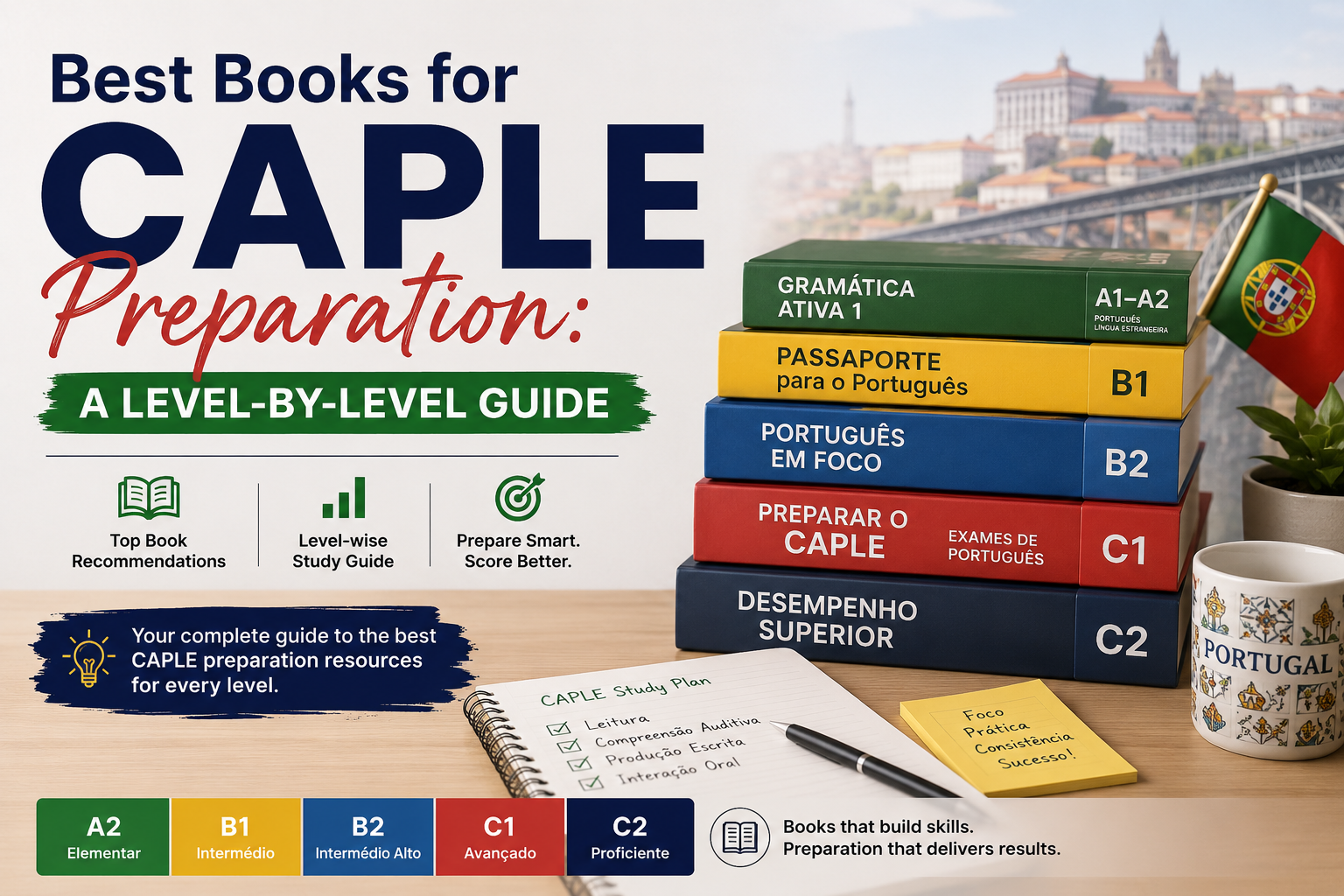
If you are preparing for the CAPLE exam, choosing the right study material is one of the most important decisions you will make before exam day. The wrong book, whether it is pitched at the wrong level or focused on Brazilian rather than European Portuguese, can slow your progress significantly.
CAPLE (Centro de Avaliacao de Portugues Lingua Estrangeira) is Portugal's official Portuguese proficiency certification, conducted by the Faculty of Arts and Humanities at the University of Lisbon. It covers six levels aligned to the Common European Framework of Reference (CEFR): from A1 (DEPLE) through to C2 (DCPLE). For a full breakdown of each level and what it qualifies you for, see our CAPLE Exam Guide.
This guide covers the most reliable books for CAPLE preparation at each level, what each one focuses on, and how to build a structured study plan around them.
Important: CAPLE assesses European Portuguese, not Brazilian Portuguese. Always verify that any book or resource you use specifies European Portuguese ("Portugues Europeu") before purchasing. Many popular Portuguese learning books default to Brazilian Portuguese without clearly stating it.
Not every Portuguese language book will serve your exam preparation equally well. Before choosing, check for the following.
Level match: The book should be written for your current proficiency level, not the level you are targeting. Building from your current level upward is more effective than attempting materials designed for where you want to be.
Skill coverage: CAPLE tests four skills: reading, writing, listening, and speaking. A good preparation book addresses all four, or you supplement with additional resources for any gaps.
Grammar and vocabulary in context: Grammar-only books are useful for reference, but CAPLE rewards language used naturally and appropriately. Books that teach grammar through exercises and real texts are more useful than those focused purely on rules.
Practice tests with answer keys: Timed mock tests are essential in the final weeks of preparation. A book that includes full practice exams with keys allows you to simulate real exam conditions and identify weak areas.
European Portuguese audio: The listening component of CAPLE uses European Portuguese, which sounds different from Brazilian Portuguese. Books with accompanying audio should use European Portuguese speakers.
All books listed below focus on European Portuguese and are published by LIDEL, the leading Portuguese educational publisher, unless otherwise stated. All are widely used in Portuguese language schools and by independent learners preparing for CAPLE exams.
| Book Title | Author(s) | Publisher | CAPLE Level | Best For | Skills Covered |
| Exames de Portugues CAPLE-UL | LIDEL Editorial Team | LIDEL | A2, B1, B2 | Exam format practice and timed mock tests | Reading, Writing, Listening, Speaking |
| Passaporte para Portugues 1 | Jose Pascoal, Paula Tavares | LIDEL | A1/A2 (CIPLE) | Complete beginners building toward A2 | All four skills with communicative focus |
| Passaporte para Portugues 2 | Jose Pascoal, Paula Tavares | LIDEL | B1 (DIPLE) | Intermediate learners preparing for B1 | All four skills |
| Portugues em Foco 2 | Graca Dias, Joao Paulo Tavares | LIDEL | B1 | Structured progression with vocabulary focus | Reading, Writing, Grammar |
| Portugues em Foco 3 | Graca Dias, Joao Paulo Tavares | LIDEL | B2 (DAPLE) | Upper-intermediate exam preparation | Reading, Writing, Grammar, Listening |
| Portugues em Foco 4 | Graca Dias, Joao Paulo Tavares | LIDEL | C1/C2 | Advanced reading, writing, and complex grammar | Reading, Writing, Grammar |
| Gramatica Ativa 1 | Fernanda Costa, Luisa Mendes, Olga Agrelo | LIDEL | A1 to B1 | Grammar consolidation at beginner to intermediate | Grammar with exercises |
| Gramatica Ativa 2 | Fernanda Costa, Luisa Mendes, Olga Agrelo | LIDEL | B1 to C1 | Grammar consolidation at intermediate to advanced | Grammar with exercises |
| Gramatica Aplicada (A1-B1) | Carla Oliveira, Luisa Coelho | LIDEL | A1 to B1 | Systematic grammar study with practice tasks | Grammar, Vocabulary |
| Gramatica Aplicada (B2-C1) | Carla Oliveira, Luisa Coelho | LIDEL | B2 to C1 | Advanced grammar including subjunctive and complex tenses | Grammar, Vocabulary |
Note on Brazilian Portuguese books: Popular titles such as Ponto de Encontro, Modern Brazilian Portuguese Grammar, and many Duolingo resources focus on Brazilian Portuguese. These are not suitable as primary CAPLE preparation materials, as vocabulary, pronunciation, and some grammar structures differ.
For learners targeting the CIPLE (A2) exam, which is the most commonly taken level for Portuguese citizenship and residency, the recommended starting combination is:
● Passaporte para Portugues 1 as the main course book, covering grammar, vocabulary, and everyday communication in a structured format with audio
● Gramatica Ativa 1 alongside it for grammar reinforcement through exercises
● Exames de Portugues CAPLE-UL for practice tests in the final four to six weeks before the exam
For B1 (DIPLE):
● Passaporte para Portugues 2 or Portugues em Foco 2 as the main text
● Gramatica Ativa 1 (if not already completed) or Gramatica Ativa 2 for grammar at this level
● Exames de Portugues CAPLE-UL for timed exam practice
The DAPLE at B2 requires more complex reading texts, longer writing tasks, and more sophisticated grammar. The recommended combination is:
● Portugues em Foco 3 as the primary text, which is specifically structured for B2 and includes reading, writing, and grammar at this level
● Gramatica Aplicada (B2-C1) or Gramatica Ativa 2 for grammar work
● Exames de Portugues CAPLE-UL for exam format practice
● Supplementary reading from Portuguese-language newspapers (Publico and Observador are both accessible online) to build reading speed and vocabulary
At the advanced levels, dedicated exam preparation books are less readily available. The recommended approach is:
● Portugues em Foco 4 for structured reading, writing, and complex grammar practice
● Gramatica Aplicada (B2-C1) for advanced grammar
● Official CAPLE sample papers from the University of Lisbon website (caple.letras.ulisboa.pt)
● Extensive reading of Portuguese literary texts and academic writing
● Listening to RTP (Radio e Televisao de Portugal) programming for authentic European Portuguese at a natural speaking pace
Books alone are rarely enough for a well-rounded CAPLE preparation. The following free and low-cost resources complement structured book study effectively.
Official CAPLE sample tests: The University of Lisbon publishes sample materials and exam guidance at caple.letras.ulisboa.pt. These are the most accurate representation of the actual exam format and should be used regularly.
Portuguese newspapers and websites: Publico (publico.pt) and Observador (observador.pt) are written in standard European Portuguese and are suitable for intermediate to advanced learners. Reading articles daily builds vocabulary and reading speed.
Podcasts and radio: RTP Radio (rtp.pt/play/radio) offers European Portuguese speech at a natural pace across multiple formats including news, culture, and conversation. The "Portugues em dia" podcast by RTP is specifically designed for learners.
Vocabulary flashcard apps: Anki allows you to create or download custom decks of Portuguese vocabulary organised by CEFR level. Consistent daily revision of 10 to 20 new words makes a measurable difference over weeks.
Speaking practice: The speaking component of CAPLE is assessed live. Practising with a qualified instructor who can give feedback on your pronunciation and fluency is the most efficient way to prepare for this component. For support with pronunciation specifically, our Portuguese Pronunciation Guide covers the key sounds and common mistakes.
Structured language courses: For learners who want guided preparation rather than self-study, a course taught by a qualified instructor provides direction, feedback, and accountability that books alone cannot replicate.
A structured weekly schedule covering all four skills is more effective than irregular, volume-heavy sessions. The plan below works for most CAPLE levels and can be adjusted based on how much time you have before your exam date.
| Day | Focus | Suggested Activity |
| Monday | Vocabulary and Grammar | One grammar unit from your course book and 20 new vocabulary items in Anki (45 min) |
| Tuesday | Listening | One listening exercise from your prep book or 30 minutes of RTP Radio or podcast (30 min) |
| Wednesday | Writing | One writing task from your prep book, written under time pressure (45 min) |
| Thursday | Speaking | Practice aloud using prompts from your book, or speaking session with an instructor (30 min) |
| Friday | Reading | One or two reading texts from your prep book or a Portuguese newspaper (45 min) |
| Saturday | Timed Mock Test | Full timed practice exam under real exam conditions (90 to 120 min) |
| Sunday | Review and Rest | Review errors from Saturday's test, revise weak areas, and rest |
In the final four weeks before your exam, increase mock test frequency to twice per week and reduce new grammar study. Exam familiarity and confidence under timed conditions matter as much as new knowledge at this stage.
Using only one book. No single book covers all four CAPLE skills equally well. Combining a course book, a grammar reference, and an exam practice book gives you the most complete preparation.
Ignoring listening and speaking. Many candidates over-prepare for reading and writing because the resources are more abundant. CAPLE's listening and speaking components carry significant weight and require their own focused preparation.
Practising grammar only. Grammar knowledge without communication practice does not translate into exam performance. Spend at least as much time on speaking, listening, and writing as on grammar study.
Not doing timed mock tests. Familiarity with the exam format and time pressure significantly affects performance. Candidates who have not practised under timed conditions consistently underperform relative to their actual ability.
Using Brazilian Portuguese materials. This is the single most common and most damaging mistake. CAPLE tests European Portuguese. If your listening, reading, and writing practice has been based on Brazilian Portuguese, you will face unfamiliar sounds, vocabulary, and written conventions in the exam.
Choosing the right books is the first step. Using them effectively alongside guided instruction and regular speaking practice is what gets candidates across the line.
Linguapol offers structured Portuguese language courses aligned to CEFR levels, including preparation programmes for CAPLE exams. Courses focus on practical communication across all four skills, with direct feedback on writing and speaking from experienced instructors.
If you are serious about passing CAPLE, structured guidance makes a measurable difference compared to self-study alone. Explore the Portuguese language course at LinguaPol and find a programme that fits your level and your exam timeline
The most effective CAPLE preparation combines a main course book matched to your current level, a grammar reference for systematic study, and regular timed practice using official-format exam papers. All materials should be in European Portuguese.
For most levels, the LIDEL series, including Passaporte para Portugues, Portugues em Foco, Gramatica Ativa, and the CAPLE-UL exam practice book, covers everything you need as a foundation. Supplement with official CAPLE sample tests, Portuguese media for listening, and speaking practice with a qualified instructor.
Start earlier than you think you need to. The most common reason candidates underperform is not lack of language ability, but lack of exam-specific preparation in the final weeks.
Contact LinguaPol to explore CAPLE preparation courses and find the support structure that fits your goals and timeline.
For CAPLE A2 (CIPLE), the recommended combination is Passaporte para Portugues 1 as the main course book, Gramatica Ativa 1 for grammar practice, and Exames de Portugues CAPLE-UL for timed mock tests in the final four to six weeks. For B1 (DIPLE), Passaporte para Portugues 2 or Portugues em Foco 2 works well as the primary text, with Gramatica Ativa 1 or 2 alongside. All are published by LIDEL and focus on European Portuguese.
For CAPLE B2 (DAPLE), Portugues em Foco 3 is the most widely recommended text at this level. It covers reading, writing, and grammar at the upper-intermediate level in European Portuguese. Combine it with Gramatica Aplicada (B2-C1) or Gramatica Ativa 2 for grammar, and Exames de Portugues CAPLE-UL for exam format practice. Supplement with regular reading of Portuguese-language news sites such as Publico (publico.pt) to build reading speed and vocabulary at this level.
Books provide the foundation, but they are rarely sufficient on their own. The speaking component requires live practice with feedback. The listening component requires authentic European Portuguese audio exposure. And exam confidence requires timed mock tests under real conditions. Most successful candidates combine books with official CAPLE sample tests, European Portuguese media for listening, and speaking practice with a qualified instructor. A structured course adds the feedback and accountability that independent study cannot always provide.
Official sample tests and exam guidance are available on the University of Lisbon's CAPLE website at caple.letras.ulisboa.pt. These are the most accurate and reliable source of exam format practice. The Exames de Portugues CAPLE-UL book, published by LIDEL, contains additional full mock exams based on the official exam structure and is the most widely used supplementary exam practice resource available in book form.
The time needed depends on your starting level and your target level. For a complete beginner targeting A2 (CIPLE), six to nine months of consistent daily study is a realistic estimate. For someone at A2 targeting B1 (DIPLE), four to six months is typical. For B1 to B2 (DAPLE), plan for six to nine months. These estimates assume 30 to 60 minutes of daily study combined with regular speaking practice and mock tests. A structured course with an experienced instructor can reduce the timeline by keeping your study focused and correcting errors before they become habits.

Instructor: Mrs Raka Adhikari

Lectures: 42

Duration: 12 Weeks

Enrolled: 20 Students

Language: Portuguese
Medium of Instruction: English & Hindi

To keep up with this era of fast-paced globalization, the one skill that remains timeless is learning languages. It continues to be one of the most highly-paid career paths available. So if you are seeking a 100% placement guarantee, just indulge with us in a world full of foreign languages.
CIN - U85500DL2024NPL433420
ISO - 9001-2015