
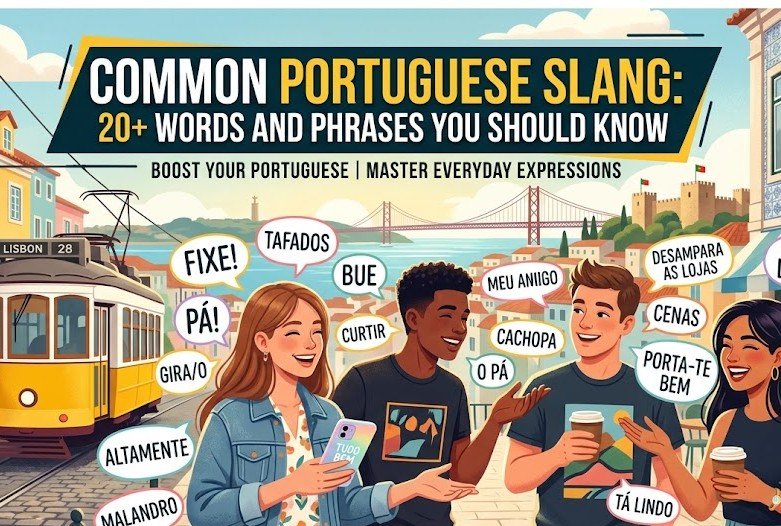
There is the Portuguese you learn in a classroom and the Portuguese you hear when you actually arrive somewhere Portuguese is spoken. The gap between them can be surprisingly wide.
Native speakers do not talk the way coursebooks are written. They drop words, run phrases together, use expressions with no direct translation, and lean on slang that most textbooks never cover. Learning to understand and use that layer of the language is what separates functional Portuguese from natural Portuguese.
This guide covers more than 20 common Portuguese slang words and phrases with their meaning, context, and a real example sentence for each. Where usage differs between Brazil and Portugal, that is clearly labelled.
Slang refers to informal words and expressions used in casual speech but not in formal writing, official settings, or standard textbooks. In Portuguese, slang tends to vary considerably between Brazil and Portugal. A term that is perfectly normal and casual in Lisbon might be unfamiliar in Sao Paulo, and vice versa.
Slang is not wrong or bad Portuguese. It is a register, a layer of language that signals belonging to a conversation, a community, or a setting. Using slang at the right moment shows fluency and cultural awareness. Using it in the wrong setting, such as in an academic email, a job application, or a formal presentation, sends the wrong signal.
When to use slang: In casual conversations with friends, in informal social situations, in text messages and informal chat.
When not to use slang: In academic or professional written communication, in formal presentations, in conversations with people you have just met in a professional context, or in official settings such as visa interviews or university admissions.
Each entry includes the term, its label (EP for European Portuguese, BP for Brazilian Portuguese, or Both), the meaning, tone, and an example sentence.
Tudo bem?
● Label: Both
● Meaning: How are you? / All good?
● Tone: Casual, friendly
● Example: "Oi! Tudo bem?" (Hi! How are you?)
● Note: "Tudo?" on its own, said with a rising tone, is an even more informal version commonly used in both countries.
Mais ou menos
● Label: Both
● Meaning: So-so / More or less
● Tone: Neutral, honest
● Example: "Como estas? Mais ou menos, estou cansado." (How are you? So-so, I'm tired.)
Bora!
● Label: Both (more common in BP, also widely used in EP)
● Meaning: Let's go! / Shall we?
● Tone: Informal, energetic
● Example: "Bora tomar um cafe?" (Shall we go grab a coffee?)
Que saudades!
● Label: Both
● Meaning: I've missed this! / I miss you so much!
● Tone: Emotional, warm
● Example: "Que saudades de Lisboa!" (I miss Lisbon so much!)
● Note: "Saudade" is a uniquely Portuguese concept with no direct English equivalent. It describes a deep feeling of longing for something or someone absent.
Boa!
● Label: Both
● Meaning: Nice! / Well done! / Great!
● Tone: Informal, enthusiastic
● Example: "Boa, passaste no exame!" (Nice one, you passed the exam!)
Que pena!
● Label: Both
● Meaning: What a shame! / Too bad!
● Tone: Casual, sympathetic
● Example: "Que pena, nao posso ir." (What a shame, I can't go.)
Nao faz mal
● Label: Both
● Meaning: No worries / It's okay / Don't worry
● Tone: Neutral, reassuring
● Example: "Desculpa o atraso! Nao faz mal." (Sorry I'm late! No worries.)
Legal!
● Label: BP
● Meaning: Cool! / Great! / Awesome!
● Tone: Informal
● Example: "Esse filme e muito legal!" (That movie is really cool!)
● Note: This is the Brazilian equivalent of "Fixe!" in European Portuguese.
Cara / Mano
● Label: BP
● Meaning: Dude / Man / Mate
● Tone: Very casual, used between close friends
● Example: "Cara, voce nao vai acreditar o que aconteceu!" (Dude, you won't believe what happened!)
● Note: Used to address friends informally. Avoid in formal settings.
Valeu!
● Label: BP
● Meaning: Thanks! / Cool! / Cheers!
● Tone: Informal
● Example: "Valeu, amigo, voce me ajudou muito!" (Thanks, buddy, you helped me a lot!)
Tipo
● Label: BP (very common), occasional in EP
● Meaning: Like / Sort of / Kind of (filler word)
● Tone: Very casual, often overused by younger speakers
● Example: "E tipo muito dificil de explicar." (It's like really hard to explain.)
● Note: Overuse of "tipo" as a filler signals very informal speech and can sound unclear in professional settings.
Que chato!
● Label: BP (also used in EP with slightly different nuance)
● Meaning: How annoying! / What a bore! / That's frustrating!
● Tone: Casual complaint
● Example: "Que chato, perdi o onibus de novo!" (How annoying, I missed the bus again!)
Massa!
● Label: BP
● Meaning: Awesome! / Wicked! / Amazing!
● Tone: Informal, enthusiastic
● Example: "Essa festa esta massa!" (This party is awesome!)
Ne?
● Label: BP
● Meaning: Right? / Isn't it? / Yeah?
● Tone: Casual tag word added to the end of sentences
● Example: "Esta quente hoje, ne?" (It's hot today, right?)
● Note: "Ne?" is one of the most distinctive features of informal Brazilian spoken Portuguese.
Fixe!
● Label: EP
● Meaning: Cool! / Great! / Awesome!
● Tone: Informal
● Example: "Essa musica e muito fixe!" (That music is so cool!)
● Note: One of the most recognisable pieces of European Portuguese slang. Not used in Brazil.
Pois
● Label: EP
● Meaning: Right / Yes / Indeed / Exactly
● Tone: Conversational filler, casual agreement
● Example: "Tens razao. Pois, eu tambem acho." (You're right. Yeah, I think so too.)
● Note: "Pois" is one of the most frequently used conversational fillers in Portugal. You will hear it constantly.
Epá!
● Label: EP
● Meaning: Wow! / Oh man! / Hey!
● Tone: Informal, expressive
● Example: "Epa, que transito incrivel!" (Oh man, what incredible traffic!)
● Note: Used to express surprise, mild frustration, or emphasis. Not appropriate in formal settings.
Bue
● Label: EP (particularly Lisbon and urban youth slang)
● Meaning: A lot / Very / Really
● Tone: Very informal, youth slang
● Example: "Esta bue calor hoje." (It's really hot today.)
● Note: "Bue" is regional to Lisbon and urban Portuguese youth culture. It may not be understood or used the same way in other parts of Portugal.
Ganda
● Label: EP
● Meaning: Great / Huge / Excellent (used as an intensifier)
● Tone: Informal, enthusiastic
● Example: "Ganda festa!" (What a great party!)
● Note: Used to express strong approval or to intensify a noun. Informal only.
Va la!
● Label: EP
● Meaning: Come on! / Alright then! / Fine!
● Tone: Informal
● Example: "Va la, nao sejas chato!" (Come on, don't be annoying!)
● Note: Tone changes the meaning completely. Said warmly, it is encouraging. Said flatly, it signals resignation.
Bacano
● Label: EP (becoming less common among younger speakers)
● Meaning: Cool / Nice / A decent person
● Tone: Informal, slightly dated
● Example: "Ele e um tipo muito bacano." (He's a really decent guy.)
Portuguese is one language, but slang is deeply local. A few examples where learners should be careful:
| Situation | European Portuguese | Brazilian Portuguese |
| Saying "cool" informally | Fixe! | Legal! / Massa! |
| Casual agreement / filler | Pois | Ne? |
| Expressing surprise | Epa! | Nossa! / Caramba! |
| Saying "a lot / very" (informal) | Bue | Muito / Demais |
| Calling someone "dude" | Za / tipo (less common) | Cara / Mano |
The practical takeaway: if you are learning Portuguese for Portugal, focus on European Portuguese slang. If your goal is Brazil, focus on Brazilian variants. Mixing the two freely in conversation can sound inconsistent and may confuse native speakers.
Some informal expressions are harmless in the right context but can come across as rude, overly familiar, or offensive in others.
Gato / Gata (Both): Literally "cat," used to call someone attractive. Common in casual conversation between friends. Can be flattering or feel forward depending on context and delivery. Avoid using it toward strangers or in professional settings.
Bue (EP): Fine among Lisbon youth but may sound odd or affected to older speakers or people from other regions of Portugal. Read your audience before using it.
Tipo as a filler (BP): Using "tipo" every few words signals very casual speech and can make you difficult to understand in a sentence. Use it sparingly if at all.
Literal translations: Some English expressions translate badly into Portuguese slang. "Que fixe" works, but translating "that's sick" directly does not produce natural Portuguese. Always learn slang as complete fixed expressions rather than building them word by word from English.
At a restaurant:
● Faz favor: Calling the waiter's attention ("Excuse me / Please")
● A conta, por favor: Asking for the bill
● Esta optimo!: "This is great!" (about the food)
Shopping:
● Quanto custa?: "How much is it?"
● Esta caro: "It's expensive"
● Que barato!: "How cheap! / What a bargain!"
Meeting people:
● Tudo bem?: "How are you?"
● Prazer em conhecer-te / conhece-lo: "Nice to meet you" (informal / formal)
● Somos da India: "We're from India"
Asking for help:
● Pode ajudar-me? / Pode me ajudar?: "Can you help me?" (EP / BP)
● Nao percebi: "I didn't understand" (EP)
● Nao entendi: "I didn't understand" (BP)
Casual conversation:
● Que fixe! / Que legal!: "How cool!" (EP / BP)
● Va la!: "Come on / Alright!"
● Ate logo!: "See you later!"
Learning slang from a list is a starting point. Using it naturally takes more.
● Watch Portuguese and Brazilian content. Netflix series, YouTube channels, and TikTok accounts in Portuguese are among the fastest ways to hear slang in real context. Notice how expressions are used, not just what they mean.
● Learn phrases as complete units. "Nao faz mal" is a fixed expression. Do not try to construct it from its literal parts. Treat it as a single chunk with a single meaning.
● Build formal Portuguese first. Slang makes sense when you have a foundation to place it against. Learners who jump straight to slang often sound inconsistent because they lack the formal register to contrast it with.
● Practice with native speakers. Real conversations expose you to tone, timing, and context that no word list can replicate.
● Start with the most common expressions. "Tudo bem?", "Fixe!" or "Legal!", "Nao faz mal," and "Bora!" will serve you immediately across a wide range of situations.
For a structured foundation that takes you from formal Portuguese into confident everyday conversation, explore the Portuguese language course at Linguapol.
Understanding slang is one part of real Portuguese fluency. Knowing when to use it, how to respond to it, and how to switch registers between formal and informal speech is something that develops through guided, structured learning.
Linguapol offers Portuguese language courses for all levels, built around practical communication including everyday vocabulary, conversational practice, and cultural context. Whether you are preparing for travel, university study, a professional move to Portugal, or the CAPLE exam, courses are structured to take you from classroom Portuguese to real-world confidence.
Explore the Portuguese language course at Linguapol and start building the language foundation that makes slang make sense.
Portuguese slang is not a luxury for advanced learners. It is part of what real Portuguese actually sounds like. Knowing that "Fixe!" means cool in Portugal, "Legal!" means cool in Brazil, "Pois" is a conversational filler, and "Va la!" can mean anything from encouragement to mild resignation gives you a much more accurate picture of the language.
Start with the expressions that come up most often. Use them in context. Build your formal foundation alongside them. And remember that slang is always about register: the right word in the right setting, not the cleverest word in every situation.
No, it differs considerably. Brazil and Portugal share the same core grammar and vocabulary, but informal slang varies significantly. "Fixe!" is the go-to informal word for "cool" in Portugal; in Brazil, "Legal!" or "Massa!" are used instead. "Pois" is a constant conversational filler in Portugal with almost no equivalent in Brazilian everyday speech, while "Ne?" is used constantly in Brazil as a tag word with little parallel in European Portuguese. Slang is one of the areas where the two variants of Portuguese diverge most noticeably.
"Tudo bem?" is one of the most universally used expressions across all Portuguese-speaking countries. It means "How are you?" or "All good?" and is appropriate in almost any casual setting. In Portugal, "Fixe!" for "cool" and "Pois" as a conversational filler are among the most frequently heard informal expressions. In Brazil, "Legal!" for "cool" and "Ne?" as a tag word are heard constantly in everyday conversation.
Not particularly, as long as you approach it correctly. The challenge is not memorisation but context: understanding when and with whom each expression is appropriate, and recognising that the same word can sound natural with friends and awkward in a professional setting. Learning slang as complete fixed phrases rather than trying to construct them word by word from English is the most effective approach for most learners.
Yes, but selectively. Beginners benefit from learning the most common everyday expressions, such as "Tudo bem?", "Fixe!" or "Legal!", "Nao faz mal," and "Bora!," from the start, because these come up constantly in real conversation. More niche or regional slang, such as "Bue" or "Ganda" in Portugal, is better introduced once you have a solid formal foundation. Using a wide range of slang too early, before you have the grammar to support it, can make your Portuguese sound inconsistent.
A structured course that combines grammar, vocabulary, and conversational practice is the most efficient path to learning real, everyday Portuguese. Self-study apps are useful for daily practice but typically focus on formal or written language rather than the conversational patterns and slang that come up in real speech. LinguaPol offers Portuguese courses for all levels with a focus on practical communication including everyday vocabulary, informal speech, and cultural context. Explore the Portuguese language course at Linguapol to find a programme that fits your level and goals.

Instructor: Mrs Raka Adhikari

Lectures: 42

Duration: 12 Weeks

Enrolled: 20 Students

Language: Portuguese
Medium of Instruction: English & Hindi

To keep up with this era of fast-paced globalization, the one skill that remains timeless is learning languages. It continues to be one of the most highly-paid career paths available. So if you are seeking a 100% placement guarantee, just indulge with us in a world full of foreign languages.
CIN - U85500DL2024NPL433420
ISO - 9001-2015