
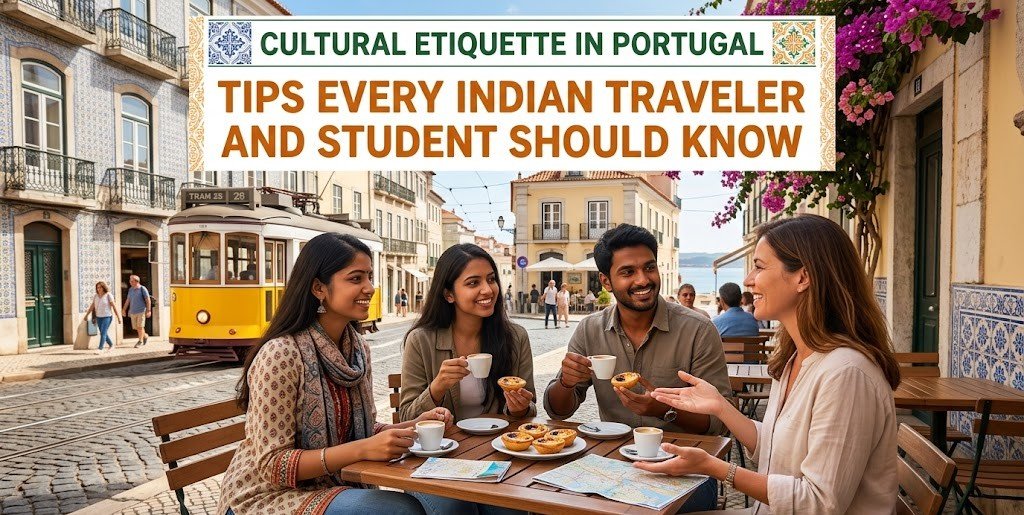
Portugal is one of the most welcoming countries in Europe. It is consistently ranked among the safest countries in the world by the Global Peace Index, and its people are known for being warm, hospitable, and patient with visitors.
That said, Portuguese culture has its own distinct rhythms, customs, and social expectations. Some of these will feel familiar to Indian travellers and students. Others will be noticeably different. Knowing what to expect before you arrive helps you navigate those differences with confidence rather than uncertainty.
This blog covers the most practical cultural points: how people greet each other, how meals work, what to wear and where, what to expect in a university or workplace, and a handful of common situations where Indian visitors sometimes get caught off guard.
In Portugal, greetings are physical and warm. The most common greeting between two women, or between a man and a woman who know each other, is two kisses on the cheek, starting from the right. Men typically greet each other with a firm handshake.
In more formal settings, a handshake is standard for both men and women on a first meeting. As the relationship develops, the cheek kiss becomes more common.
For Indian students arriving at a Portuguese university, this can feel unfamiliar at first. The key is to take cues from the other person. If someone leans in for a cheek greeting, reciprocate naturally. If they extend a hand, shake it.
Real-life example: An Indian student meeting their university flatmates for the first time may be greeted with a cheek kiss from female housemates. This is a normal sign of warmth, not an imposition of personal space.
Portuguese has two registers of "you": "voce" (formal) and "tu" (informal). In professional settings, university classrooms, and with people you have just met, "voce" is appropriate.
Professors are addressed as "Professor" or "Professora," followed by their surname in more formal interactions. Calling a professor by their first name without invitation is generally considered inappropriate, unlike in some Indian institutions where "Sir" or "Ma'am" covers all situations.
In casual social settings among peers, "tu" becomes the norm quickly, especially in younger circles.
Portuguese social culture tends to be relaxed about time in casual settings. Arriving ten to fifteen minutes late to a dinner invitation at someone's home is usually acceptable and sometimes even expected. However, punctuality is expected in professional and academic contexts: arriving late to a lecture, job interview, or business meeting without notice is considered disrespectful.
Communication style in Portugal is generally indirect and polite. Confrontational or blunt feedback, even when well-intentioned, can come across as rude. If you are used to direct communication, adjusting your tone in professional settings will help you build better relationships.
Portugal follows a distinctly European meal schedule that differs significantly from Indian norms.
● Lunch is the main meal of the day and is typically eaten between 12:30 and 2:30 pm. Many restaurants still close between 3:00 and 7:00 pm.
● Dinner is served late, usually between 8:00 and 10:00 pm. Arriving at a restaurant at 6:30 pm may mean you are the only person there.
Many Portuguese restaurants place bread, olives, cheese, or other small items on your table as soon as you sit down. This is called the "couvert." It is not free. These items are charged separately and will appear on your bill whether you eat them or not.
If you do not want the couvert, you can politely ask the waiter to remove it. Sending it back before eating anything means it will not be charged.
Tipping is appreciated in Portugal but not mandatory. A tip of around 10 percent for good service at a sit-down restaurant is considered generous and appropriate. Leaving your small coins on the table is also a common local practice.
Wait until your host or the oldest person at the table begins eating before you start. Keep both hands visible on the table rather than in your lap during a meal. Talking with your mouth full is considered poor form.
Portugal has a rich food culture centred on meat, fish, and seafood. Vegetarian options exist but are limited in traditional restaurants, particularly outside Lisbon and Porto. Many dishes that appear vegetarian may contain meat-based stock or small quantities of fish.
Practical tip for Indian vegetarians: Research restaurants in advance using apps like HappyCow. Lisbon and Porto both have dedicated vegetarian and vegan restaurants. In smaller cities and towns, asking "sem carne, sem peixe" (without meat, without fish) at restaurants gives you the best chance of finding suitable options.
Portugal has a fairly relaxed dress culture in everyday settings. Smart casual is appropriate for most occasions. However, a few settings have specific expectations:
● Churches and religious sites: Shoulders and knees must be covered. Many churches provide scarves or coverings if needed, but carrying one is a safer option.
● Beaches: Beachwear is appropriate at the beach but not in cafes, shops, or restaurants near the coast.
Photography in public spaces is generally permitted. However, photographing people, especially in close-up or in private moments, without asking is considered intrusive. In museums, galleries, and some churches, photography may be restricted. Check for signs or ask a staff member before taking photos indoors.
Portuguese urban culture values quiet in shared spaces. Speaking loudly in cafes, libraries, public transport, or residential corridors in the evening is frowned upon. Many apartment buildings have unspoken rules about noise after 11:00 pm, and local law in some municipalities formalises quiet hours.
Real-life example: An Indian student accustomed to studying in a group with background conversation may find that Portuguese libraries and study areas expect near-silence. Finding the right space for collaborative study versus quiet independent work is worth sorting out early.
Portuguese university culture is more formal than what many Indian students encounter at Indian private universities. Lectures are generally not interactive unless the professor specifically invites questions. Interrupting a professor mid-lecture to ask a question is unusual.
Attendance is taken seriously. In many programmes, excessive absences affect your grade or your ability to sit the final exam. Check your course rules early in the semester.
Email is the standard way to contact professors outside class. Emails should be written formally, beginning with "Caro Professor" or "Cara Professora" (Dear Professor), and should be concise and clear. A friendly, casual tone in written communication with a professor can come across as disrespectful.
Real-life example: An Indian student who sends a WhatsApp-style message ("Hey prof, just checking about the assignment") may find their professor does not respond, or responds more coolly than expected. A formal email gets a faster and warmer reply.
Portuguese workplaces tend to be hierarchical. Managers and senior colleagues are addressed formally until they indicate otherwise. Building rapport and trust takes time. Jumping straight to task-focused conversation without some small talk and relationship-building can come across as cold or transactional.
| Situation | Do | Avoid |
| Meeting someone for the first time | Offer a handshake or reciprocate a cheek greeting | Refusing physical greetings without explanation |
| At a restaurant | Ask to remove the couvert if you do not want it | Assuming bread and olives on the table are free |
| Emailing a professor | Use formal salutation and professional tone | Casual or informal language in academic emails |
| Visiting a church or chapel | Cover shoulders and knees | Entering in beachwear or shorts |
| Eating at someone's home | Wait for the host to begin before eating | Starting before others |
| In a library or study area | Speak quietly or use headphones | Loud group conversations |
| Taking photographs | Ask permission when photographing individuals | Photographing people without their knowledge |
| Arriving at a social dinner | 10 to 15 minutes late is acceptable | Being significantly early without notice |
Learning even a handful of Portuguese phrases before arriving makes a visible difference in how locals respond to you. Portuguese people genuinely appreciate the effort, even when your pronunciation is imperfect.
| English | Portuguese | Pronunciation Guide |
| Hello | Ola | OH-lah |
| Good morning | Bom dia | bom JEE-ah |
| Good afternoon | Boa tarde | BOH-ah TAR-day |
| Good evening | Boa noite | BOH-ah NOY-tay |
| Thank you (said by a man) | Obrigado | oh-bree-GAH-doo |
| Thank you (said by a woman) | Obrigada | oh-bree-GAH-dah |
| Please | Por favor | poor fah-VOR |
| Excuse me | Com licenca | kom lee-SEN-sah |
| I'm sorry | Desculpe | desh-KOO-peh |
| How are you? (formal) | Como esta? | KOH-moo esh-TAH |
| Do you speak English? | Fala ingles? | FAH-lah een-GLAYSH |
| I don't understand | Nao percebo | nowm pair-SEH-boo |
| Where is...? | Onde e...? | ON-day eh |
| The bill, please | A conta, por favor | ah KON-tah, poor fah-VOR |
| Without meat, without fish | Sem carne, sem peixe | seng KAR-neh, seng PAY-sheh |
For more help with getting pronunciation right, including the nasal sounds and consonant combinations that English speakers find tricky, visit our Portuguese Pronunciation Guide.
Knowing a few phrases is a good start, but building real conversational ability before you arrive makes the entire experience of living or travelling in Portugal more comfortable and more rewarding.
Portuguese people respond very warmly to visitors and students who have made the effort to learn the language, even at a basic level. It signals respect, commitment, and genuine interest in the culture.
If you are planning to study in Portugal, most undergraduate and many postgraduate programmes taught in Portuguese require proof of B2-level proficiency. Even for English-taught programmes, the language opens up more of your daily life outside the classroom.
Explore the Portuguese language course at Linguapol to find a programme that fits your level and your timeline, whether you are starting from scratch or building on some existing knowledge.
Portugal's culture is warm, hospitable, and relatively easy to navigate once you understand its rhythms. The main things to carry with you are:
● Greet people in the way they greet you, whether that is a handshake, a cheek kiss, or a simple hello
● Eat at Portuguese meal times and be aware of the couvert at restaurants
● Address professors, professors, and senior colleagues formally until you are invited to do otherwise
● Cover up at religious sites and keep noise down in shared spaces
● Use even basic Portuguese phrases wherever you can
The more you understand about the culture before you arrive, the faster you will find your footing. And the more of the language you bring with you, the more of Portugal will be genuinely accessible to you.

Instructor: Mrs Raka Adhikari

Lectures: 42

Duration: 12 Weeks

Enrolled: 20 Students

Language: Portuguese
Medium of Instruction: English & Hindi

To keep up with this era of fast-paced globalization, the one skill that remains timeless is learning languages. It continues to be one of the most highly-paid career paths available. So if you are seeking a 100% placement guarantee, just indulge with us in a world full of foreign languages.
CIN - U85500DL2024NPL433420
ISO - 9001-2015