
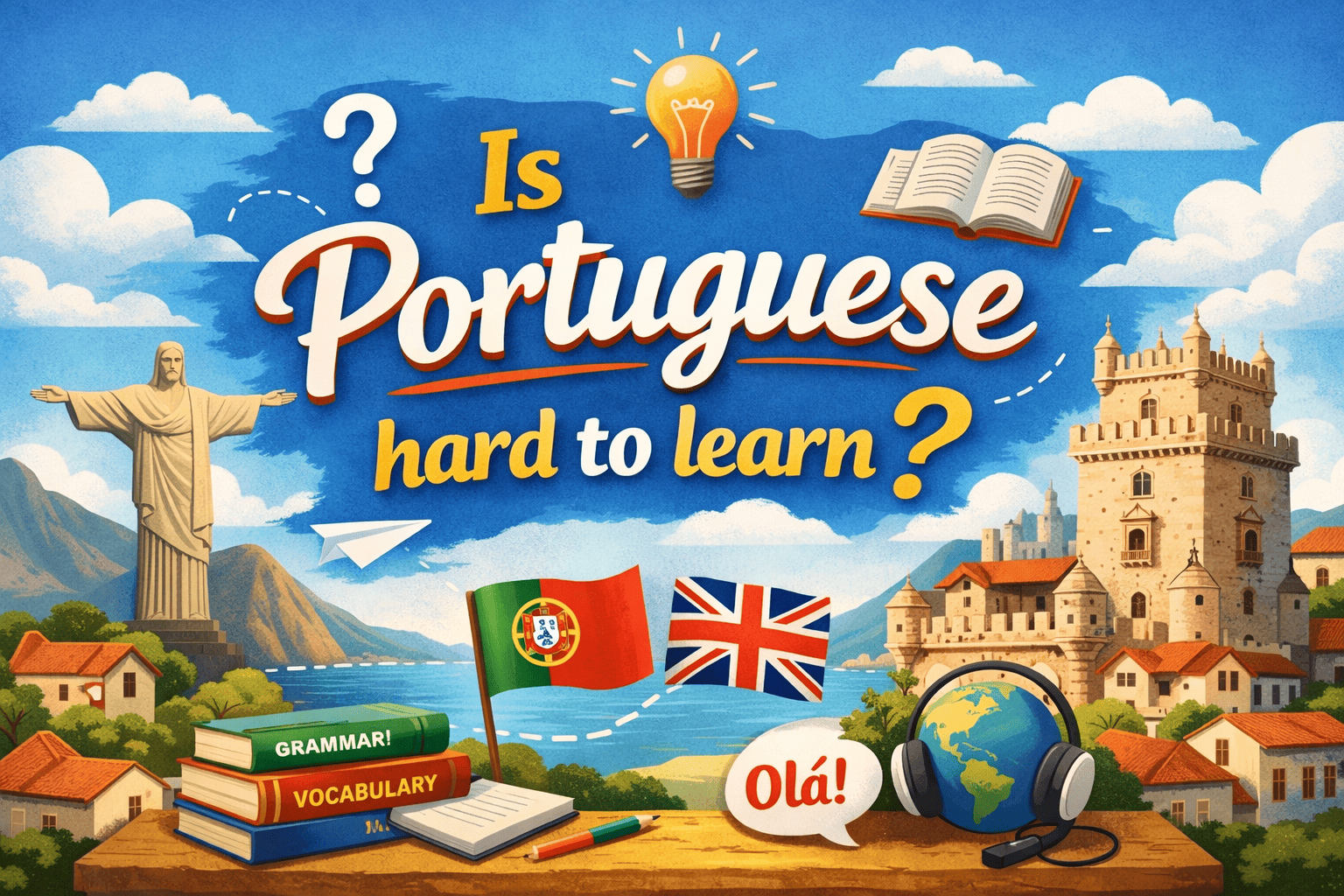
If you are thinking to learn new language, it's very natural to wonder: is Portuguese hard to learn? That's a very common question before start learning any language. Portuguese may sound unfamiliar at first, not Portuguese alone but other languages also.
This honest answer is Portuguese is not as hard as it may seem, especially when you learned this with right guidance. Like any language may feel difficult and it depend on several factors, including your native language, exposure to similar languages and how consistently you practice.
Is Portuguese hard to learn for English speakers? learning Portuguese is lightly challenging but very achievable for English speaker. It's not one of the easiest languages to learn but yeah it far from hardest, especially when it compared it with different writing system and unfamiliar grammar rules.
Many leaners who know English are pleasantly surprised once they start learning portguese language. Several aspects of the Portuguese language actually make it easier for beginners.
Portuguese language sentence structure is logical and consistent that once you understand that basic patterns, forming simple sentence become easier.
Both languages have same roots where the large number of words look or sound familiar at first for English speaker, this makes learning Portuguese for beginner become faster and less frustrating.
Examples:
But still learning new language brings some challenges for every leaners – understanding all these areas in advance can make learning process smoother and less frustrating.
Most challenging part of Portuguese languages is pronunciation. Language has nasal sounds and vowel combination that don’t exist in English. It's quite tricky when it comes to speaking.
Accents vary depending on the region, which may feel confusing at first but listening regularly to spoken Portuguese helps beginner to adjust quickly.
Portuguese Grammar includes more verb conjugation than English and including verbs change depending on subject, tense and mood, that take time to get used to.
Once you understand patterns and conjugation that become easier to practice rather than memorization.
Another common challenge is choosing right one between Brazilian Portuguese vs European Portuguese. Brazilian Portuguese is often considered easier for beginner because of clear structure for pronunciation. While you can learn easily Brazilian Portuguese after completing European Portuguese but not vice versa.
One of the most common question asks by new leaners how long it takes to learn Portuguese. The answer for this question depends on your learning method, efforts on learning and how consistently you practice.
With regular practice, most of the leaners can start understanding and using basic Portuguese in 2 to 3 months. With this stage, you’ll able to handle simple conversations, and ask basic questions.
For conversation level, leaners usually need 6 to 9 months of consistent efforts in study. This level includes improving pronunciation, expanding vocabulary and becoming more confident at regular speaking.
Reaching at fluency often takes 1.5 to 2.5 years, means where you can express ideas clearly and understand native speakers, but depending on how you practice Portuguese.
Instead of trying to master everything at once focus on few small, consistent steps which build confidence over time. Learning Portuguese becomes much easier when you follow right approach.
Many new learners wait for too long to start speaking because they afraid of making mistakes. Speaking with simple sentences help to recognize that language structure early and make fluent then usual speed.
Listening Portuguese native speakers help beginner to understand pronunciation, rhythm, and natural expressions. Songs, short videos and simple conversation like podcasts that best way to train your ear.
Long time marmorizing of words will not work, in spite focus on phrases and sentences used in everyday situations. This makes learning more practical and helps you to communicate naturally.
Most underrated but most important a well-structured course or tutor can guide you step by step, helping you to avoid confusion and correct when you move wrong direction which can take long time to correct it.
Learning Portuguese become much easier when you choose a structured course that align with your goals, pace and learning style. At linguapol our Portuguese course is well structured and built by our experienced educator to help individuals like industry professionals and student who want to learn Portuguese.
So, is Portuguese hard to learn? The answer in no – when your approaches towards learning Portuguese is balanced and right way. While portuguese has some challenging aspects, such as pronunciation and verb conjugation but once you master on these few challenges learning pPortuguese become much more smoother than any other languages, everything at start feels heavy to learn but once you did it, it becomes your strength and source of confidence.
Not that much but still Portuguese is slightly feeling harder due to its complex sounds and Spanish feel slightly easier due to its pronunciation and accent.
Brazilian Portuguese is considered easier for beginner because of its clearer pronunciation and slower pace. But once you learn European portuguese it becomes easier to learn Brazilian portuguese.
Many learners feel Portuguese is difficult due its unfamiliar pronunciation, nasal sounds and conjugations of verbs. But all these challenges can be overcome easily with structure guidance and regular practice.

Instructor: Mrs Raka Adhikari

Lectures: 42

Duration: 12 Weeks

Enrolled: 20 Students

Language: Portuguese
Medium of Instruction: English & Hindi

To keep up with this era of fast-paced globalization, the one skill that remains timeless is learning languages. It continues to be one of the most highly-paid career paths available. So if you are seeking a 100% placement guarantee, just indulge with us in a world full of foreign languages.
CIN - U85500DL2024NPL433420
ISO - 9001-2015