
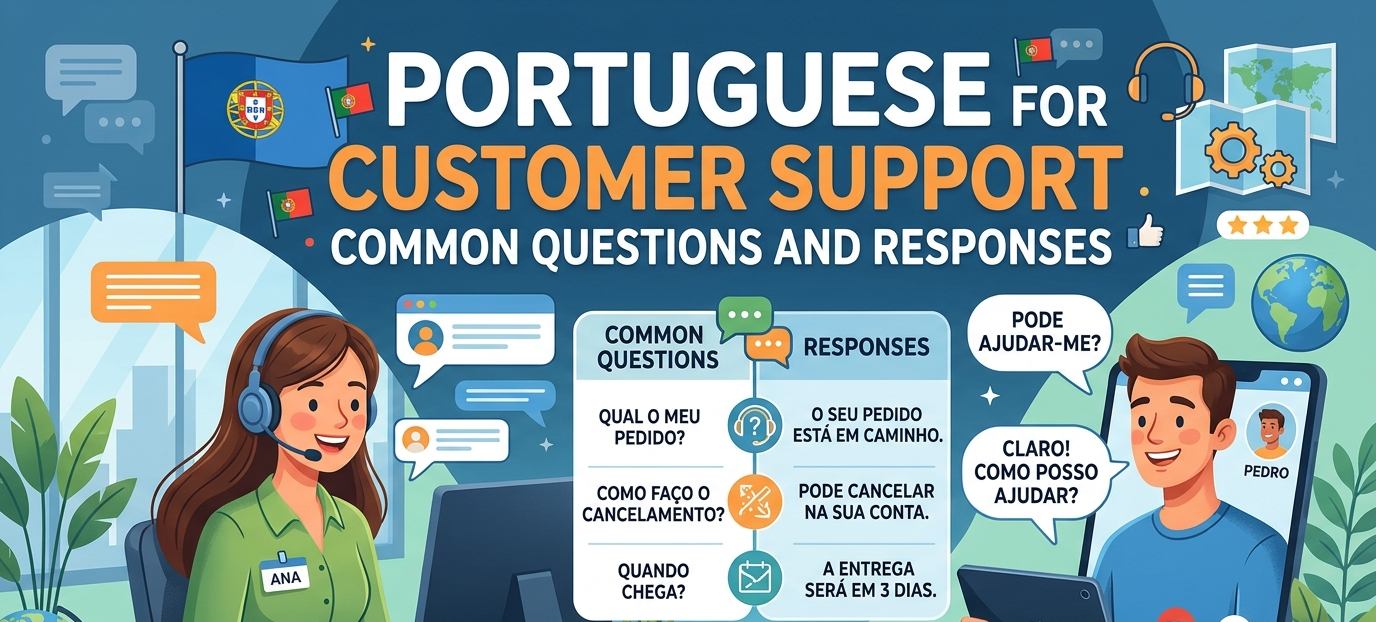
Customer support agents who work with Brazilian or Portuguese-speaking clients do not need to be fluent from day one. But knowing a set of core phrases makes a real difference in how customers feel during a conversation.
A customer who hears a support agent respond in Portuguese, even with a simple greeting or a polite confirmation, is more likely to feel heard and valued. That can directly affect customer satisfaction scores and resolution quality.
This article covers the essential phrases for portuguese for customer support, organised by situation. Each section includes the Portuguese phrase, its English meaning, and notes on Brazilian versus European Portuguese where the two differ.
The focus is on Brazilian Portuguese, which is the variety most commonly encountered in BPO and customer support roles in India. European Portuguese alternatives are noted where useful.
According to Ethnologue's language data for Portuguese, Portuguese is spoken by over 260 million people across nine countries. Brazil alone has a population of over 215 million. Many Indian BPO companies handle support operations for Brazilian businesses or international companies with Brazilian customers.
For support agents in those teams, even a basic working knowledge of customer service phrases in Portuguese reduces misunderstandings, speeds up resolution, and builds customer trust. Customers are more patient and cooperative when they feel communication is clear and respectful.
Learning how to help customers in Portuguese does not require years of study. A focused set of phrases used consistently across common support situations is a practical and achievable starting point.
The opening of a support call or chat sets the tone for the entire interaction. These Portuguese greetings for customers are used in both Brazilian and European Portuguese unless noted.
| Situation | Portuguese Phrase | English Meaning |
| General greeting | Olá | Hello |
| Morning greeting | Bom dia | Good morning |
| Afternoon greeting | Boa tarde | Good afternoon |
| Evening greeting | Boa noite | Good evening |
| Welcoming a customer | Bem-vindo(a) | Welcome |
| Opening a support interaction | Obrigado(a) por entrar em contato. Como posso ajudá-lo(a)? | Thank you for contacting us. How can I help you? |
| Introducing yourself | Meu nome é [Nome]. Como posso ajudá-lo(a) hoje? | My name is [Name]. How can I help you today? |
| Thank you | Obrigado (said by men) / Obrigada (said by women) | Thank you |
| You are welcome | De nada | You are welcome |
| Please | Por favor | Please |
European Portuguese note: "Entrar em contato" (Brazilian) becomes "entrar em contacto" in European Portuguese. The meaning is identical.
The following sections cover the situations customer support agents encounter most often.
| Customer Says (Portuguese) | English Meaning | Agent Response (Portuguese) | English Meaning |
| Preciso de ajuda. | I need help. | Claro, estou aqui para ajudá-lo(a). | Of course, I am here to help you. |
| Você pode me ajudar? | Can you help me? | Sim, com prazer. | Yes, with pleasure. |
| Tenho uma dúvida sobre minha conta. | I have a question about my account. | Entendido. Pode me dar mais detalhes? | Understood. Can you give me more details? |
| Customer Says (Portuguese) | English Meaning | Agent Response (Portuguese) | English Meaning |
| Qual é o status do meu pedido? | What is the status of my order? | Vou verificar isso agora para você. | I will check that for you now. |
| O número do meu pedido é [número]. | My order number is [number]. | Obrigado(a). Um momento, por favor. | Thank you. One moment, please. |
| Quando meu pedido vai chegar? | When will my order arrive? | Seu pedido chegará em [X] dias úteis. | Your order will arrive in [X] business days. |
| Meu pedido ainda não chegou. | My order has not arrived yet. | Peço desculpas pelo inconveniente. Vou verificar agora. | I apologise for the inconvenience. I will check now. |
European Portuguese note: "Status" (Brazilian) is replaced by "estado" in European Portuguese. "Pedido" is used in both varieties for orders.
| Customer Says (Portuguese) | English Meaning | Agent Response (Portuguese) | English Meaning |
| Meu pedido está atrasado. | My order is delayed. | Lamento o atraso. Vou verificar com nossa equipe de logística. | I am sorry for the delay. I will check with our logistics team. |
| Podem me dar o código de rastreio? | Can you give me the tracking number? | Claro. O seu código de rastreio é [número]. | Of course. Your tracking number is [number]. |
| O endereço de entrega está correto? | Is the delivery address correct? | Deixa eu confirmar. O endereço que temos é [endereço]. | Let me confirm. The address we have is [address]. |
European Portuguese note: "Equipe" (Brazilian) becomes "equipa" in European Portuguese.
| Customer Says (Portuguese) | English Meaning | Agent Response (Portuguese) | English Meaning |
| Quero devolver este produto. | I want to return this product. | Claro, posso ajudá-lo(a) com isso. | Of course, I can help you with that. |
| Quero um reembolso. | I want a refund. | O reembolso será processado em [X] dias úteis. | The refund will be processed in [X] business days. |
| Posso trocar este produto? | Can I exchange this product? | Sim, vou verificar as opções disponíveis para você. | Yes, I will check the available options for you. |
| Qual é a política de devolução? | What is the return policy? | Aceitamos devoluções em até [X] dias após a compra. | We accept returns within [X] days of purchase. |
| Customer Says (Portuguese) | English Meaning | Agent Response (Portuguese) | English Meaning |
| Fui cobrado(a) incorretamente. | I was charged incorrectly. | Vou verificar os detalhes do seu pagamento agora. | I will check your payment details now. |
| Meu pagamento não foi aprovado. | My payment was not approved. | Por favor, tente novamente com outro cartão ou método de pagamento. | Please try again with another card or payment method. |
| Posso pagar em parcelas? | Can I pay in instalments? | Sim, oferecemos parcelamento. | Yes, we offer instalment plans. |
European Portuguese note: "Parcelamento" (Brazilian) is "pagamento a prestações" in European Portuguese.
| Customer Says (Portuguese) | English Meaning | Agent Response (Portuguese) | English Meaning |
| Meu produto chegou danificado. | My product arrived damaged. | Lamento muito. Pode nos enviar uma foto do produto? | I am very sorry. Can you send us a photo of the product? |
| Recebi o produto errado. | I received the wrong product. | Peço desculpas pelo erro. Vamos resolver isso imediatamente. | I apologise for the error. We will resolve this immediately. |
| O site não está funcionando. | The website is not working. | Obrigado(a) por nos informar. Estamos verificando o problema. | Thank you for letting us know. We are checking the issue. |
Handling customer complaints professionally requires specific language. These Portuguese customer service responses help agents acknowledge concerns, ask clarifying questions, and offer a path forward.
| Phrase (Portuguese) | English Meaning | When to Use |
| Entendo a sua situação. | I understand your situation. | After a customer explains their problem |
| Peço desculpas pelo inconveniente. | I apologise for the inconvenience. | General apology for any issue |
| Lamento que isso tenha acontecido. | I am sorry this happened. | When something went wrong |
| Poderia me dar mais detalhes? | Could you give me more details? | When you need more information |
| Para confirmar, o seu nome é...? | To confirm, your name is...? | Before looking up account details |
| Vou fazer o possível para resolver isso. | I will do my best to resolve this. | Reassuring the customer |
| Vou escalar isso para a equipe responsável. | I will escalate this to the responsible team. | When escalation is needed |
| Pode aguardar um momento? | Can you hold for a moment? | Putting a customer on a brief hold |
Ending a conversation well is just as important as opening it correctly. These polite phrases leave the customer with a positive impression.
| Phrase (Portuguese) | English Meaning |
| Posso ajudá-lo(a) com mais alguma coisa? | Is there anything else I can help you with? |
| Foi um prazer ajudá-lo(a). | It was a pleasure to help you. |
| Obrigado(a) por entrar em contato. | Thank you for contacting us. |
| Tenha um ótimo dia. | Have a great day. |
| Qualquer dúvida, estamos à disposição. | For any questions, we are at your service. |
| Se precisar de mais ajuda, pode nos contatar novamente. | If you need further help, you can contact us again. |
A few practical habits can make a big difference in how smooth your customer support conversations feel.
Use formal language by default. In Brazilian Portuguese, "você" works in both formal and informal contexts. In European Portuguese, "o senhor" (for men) or "a senhora" (for women) is more appropriate in formal settings. When in doubt, stay formal.
Avoid slang and casual expressions. Customer support conversations should use standard, polite Portuguese. Slang or regional expressions can confuse customers or come across as unprofessional.
Always confirm customer details. Repeat back names, order numbers, and addresses to confirm accuracy. This reduces errors and shows the customer you are paying attention.
Keep your sentences short. Short, clear sentences are easier to understand over the phone or in a chat. This applies whether you are speaking or typing. Avoid long explanations when a direct response will work.
Practise the most common phrases regularly. The phrases in this article cover the majority of customer support situations. Practising them daily, even for 15 minutes, helps them feel natural when you need them in a real conversation.
If you want to build a stronger foundation in Portuguese for professional communication, exploring a structured course can help you move from memorised phrases to genuine fluency. You can explore Portuguese language training options at Linguapol built around real workplace communication scenarios.
Knowing a core set of customer service phrases in Portuguese is a practical and achievable goal. The tables in this article cover the situations that come up most often in support conversations: greetings, order queries, delivery issues, refunds, payment questions, complaints, and conversation closings.
The next step is to practise using these phrases in context. Read them out loud. Role-play common support scenarios with a colleague. Focus on the situations most relevant to your work.
Over time, these phrases become automatic. That is when Portuguese customer support vocabulary stops being something you have to think about and starts being something you just use.
For learners who want to go further, structured Portuguese language training focused on professional communication can help you handle more complex customer conversations with confidence. Contact Linguapol to find a course that fits your schedule and your goals.
In Brazilian Portuguese: "Obrigado(a) por entrar em contato." In European Portuguese: "Obrigado(a) por entrar em contacto." Use "Obrigado" if you are a man and "Obrigada" if you are a woman. This phrase is used at the opening and closing of a support interaction.
The most common polite apology in customer support is "Peço desculpas pelo inconveniente," which means "I apologise for the inconvenience." For a warmer, more personal expression, use "Lamento muito que isso tenha acontecido," which means "I am very sorry this happened." Both are appropriate in professional contexts.
The differences are mostly in vocabulary and formality. For example: "entrar em contato" (Brazilian) vs "entrar em contacto" (European), "equipe" (Brazilian) vs "equipa" (European), and "parcelamento" (Brazilian) vs "pagamento a prestações" (European). In terms of formality, European Portuguese typically uses "o senhor/a senhora" for formal address, while Brazilian Portuguese uses "você" across both formal and informal situations. For most BPO roles in India, Brazilian Portuguese is the standard to learn.
The standard phrase is "Posso ajudá-lo(a) com mais alguma coisa?" This works in both Brazilian and European Portuguese. It is a natural and professional way to close a support interaction while leaving the door open for further questions.
Customer support agents who work with Brazilian or Portuguese-speaking clients do not need to be fluent from day one. But knowing a set of core phrases makes a real difference in how customers feel during a conversation.
A customer who hears a support agent respond in Portuguese, even with a simple greeting or a polite confirmation, is more likely to feel heard and valued. That can directly affect customer satisfaction scores and resolution quality.
This article covers the essential phrases for portuguese for customer support, organised by situation. Each section includes the Portuguese phrase, its English meaning, and notes on Brazilian versus European Portuguese where the two differ.
The focus is on Brazilian Portuguese, which is the variety most commonly encountered in BPO and customer support roles in India. European Portuguese alternatives are noted where useful.

Instructor: Mrs Raka Adhikari

Lectures: 42

Duration: 12 Weeks

Enrolled: 20 Students

Language: Portuguese
Medium of Instruction: English & Hindi

To keep up with this era of fast-paced globalization, the one skill that remains timeless is learning languages. It continues to be one of the most highly-paid career paths available. So if you are seeking a 100% placement guarantee, just indulge with us in a world full of foreign languages.
CIN - U85500DL2024NPL433420
ISO - 9001-2015