
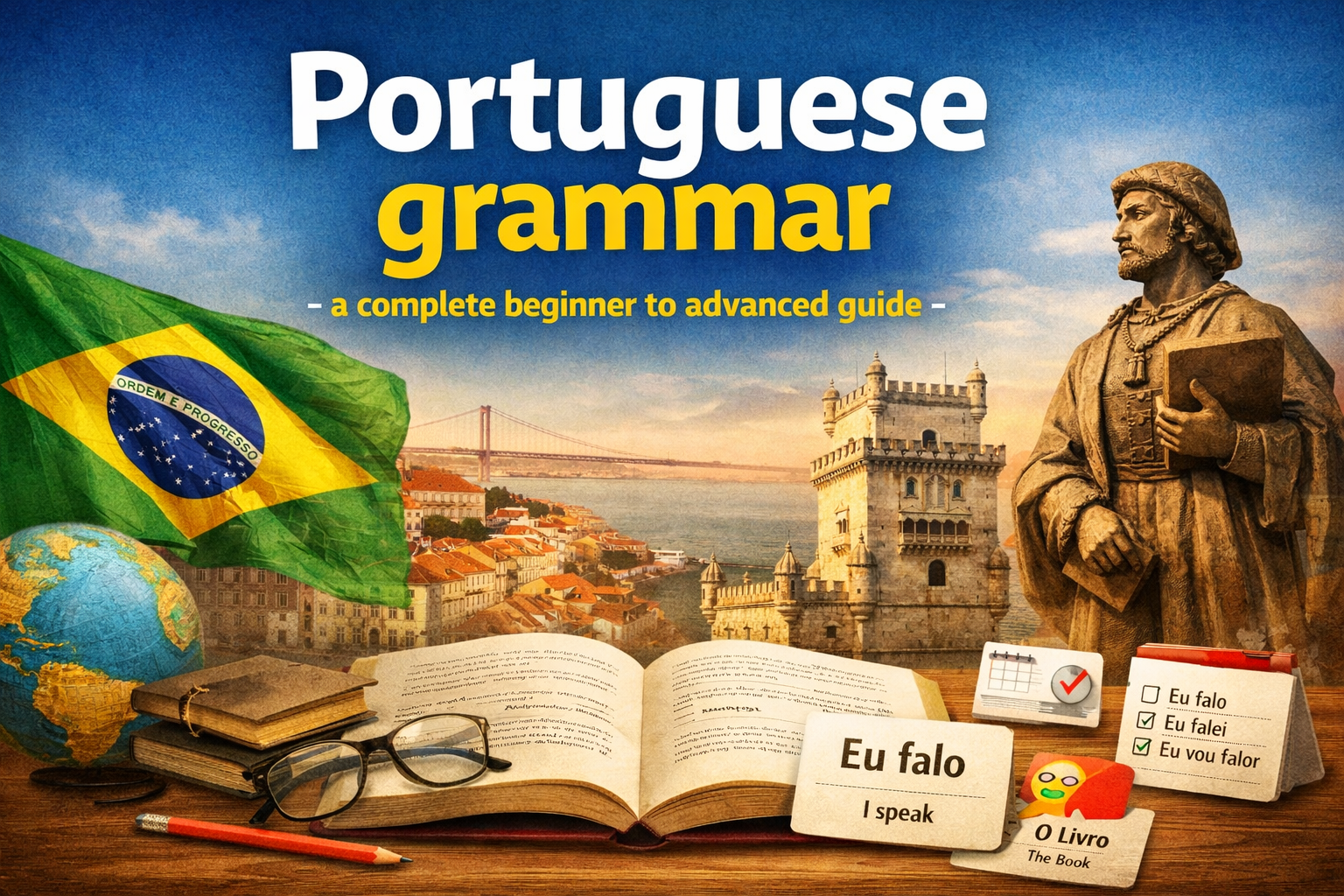
Portuguese grammar is the backbone of clear communication in one of the world’s most spoken languages.it provides the logic behind how sentence is formed and ensuring that you are understood by native speakers.
The demand for Portuguese language is very high and mastering modern Brazilian Portuguese grammar opens doors to global jobs, academic exams and deep cultural connections.
Portuguese grammar has structured rules which helps to tell how words interact in a sentence.
Portuguese generally follows SVO (subject + verb + object) pattern similar to english. Example: Eu (subject) esturdo (Verb) Português (object) - (I study Portuguese)
unlike English, every noun in Portuguese has grammatical gender that divide things in two category masculine or feminine. Like: -
Adjectives and articles must agree with nouns in genera and name. For e.g., if noun is feminine and plural, the article and adjective must also follow rule and that should be feminine and plural.
In Portuguese, adjectives usually come after nouns. However, some adjectives can appear before the noun, in this cases their placement may change the meaning of whole word.
For e.g. -
Let's move beyond basic phrases and master these four pillars of the language:
Verbs are differentiated by their category which is categorized by their ending –ar, -er and –ir. Each group follows specific patterns in the present, past, and future tenses.
Present: It is for current actions (Eu falo).
Past: It is for completed past actions (Eu falei).
Future: It is for what will happen (Eu vou falar).
Verb ending should match the suject in portuguese. Different forms are used for Eu, Você, Ele/Ela, Nós and Eles/Eles, making an agreement to make communication clear.
Prepositions like em, de and often combined with articles. For exmaole, em + a becomes na. Beginners often forget these contractions, which is a hallmark of “gromgo” Potugiese.
We can learn Portuguese grammar by these most effective rules: -
Avoid this mistake: You should not try to learn every exception at once. You must focus on the rules that cover 80% of daily conversation first.
Portugal and Brazil are mostly same in written language, but Brazilian Portuguese grammar evolved into a melodic, flexible and simplified form that make everyday speech easy.
Key Difference:
Modern Brazilian Portuguese uses in everyday speaking that makes it more flexible and conversational rather than using strict traditional written forms.
To achieve true mastery, you must learn advanced grammar that is more nuanced parts of Portuguese language.
The Fast Track to Mastering Portuguese
Self-study is a great start, but it often leads to "plateauing." To truly master the Portuguese, a structured approach is become necessary.
At linguapol we bridge the gap between "textbook" rules and "real-world" fluency. We have certified courses which offer:
Is Portuguese grammar difficult for beginners?
It can be challenging part due to its verb conjugations and gendered nouns, but because it is phonetic (it's spelled like it sounds), many find it easier to start Portuguese languages other than learning French and English.
How long does it take to learn Portuguese grammar?
With consistent daily practice, you can master basic grammar in 3–6 months. But Professional fluency can take time about 1–2 years because we all know professional always makes things in structured way.
Is Brazilian Portuguese grammar different from European Portuguese?
Yes, primarily in pronoun usage, verb placement, and the "openness" of vowels. However, written formal grammar remains largely standardized.
Do I need advanced grammar to speak fluently?
You need it to speak accurately. While you can understand basic grammar, advanced rules allow you to express nuances, emotions, and professional opinions.
What is the best way to practice daily?
Combine a grammar app with "shadowing" (repeating after native speakers). Also, try writing your daily to-do list in Portuguese using the correct imperative or future verb forms.

Instructor: Mrs Raka Adhikari

Lectures: 42

Duration: 12 Weeks

Enrolled: 20 Students

Language: Portuguese
Medium of Instruction: English & Hindi

To keep up with this era of fast-paced globalization, the one skill that remains timeless is learning languages. It continues to be one of the most highly-paid career paths available. So if you are seeking a 100% placement guarantee, just indulge with us in a world full of foreign languages.
CIN - U85500DL2024NPL433420
ISO - 9001-2015