
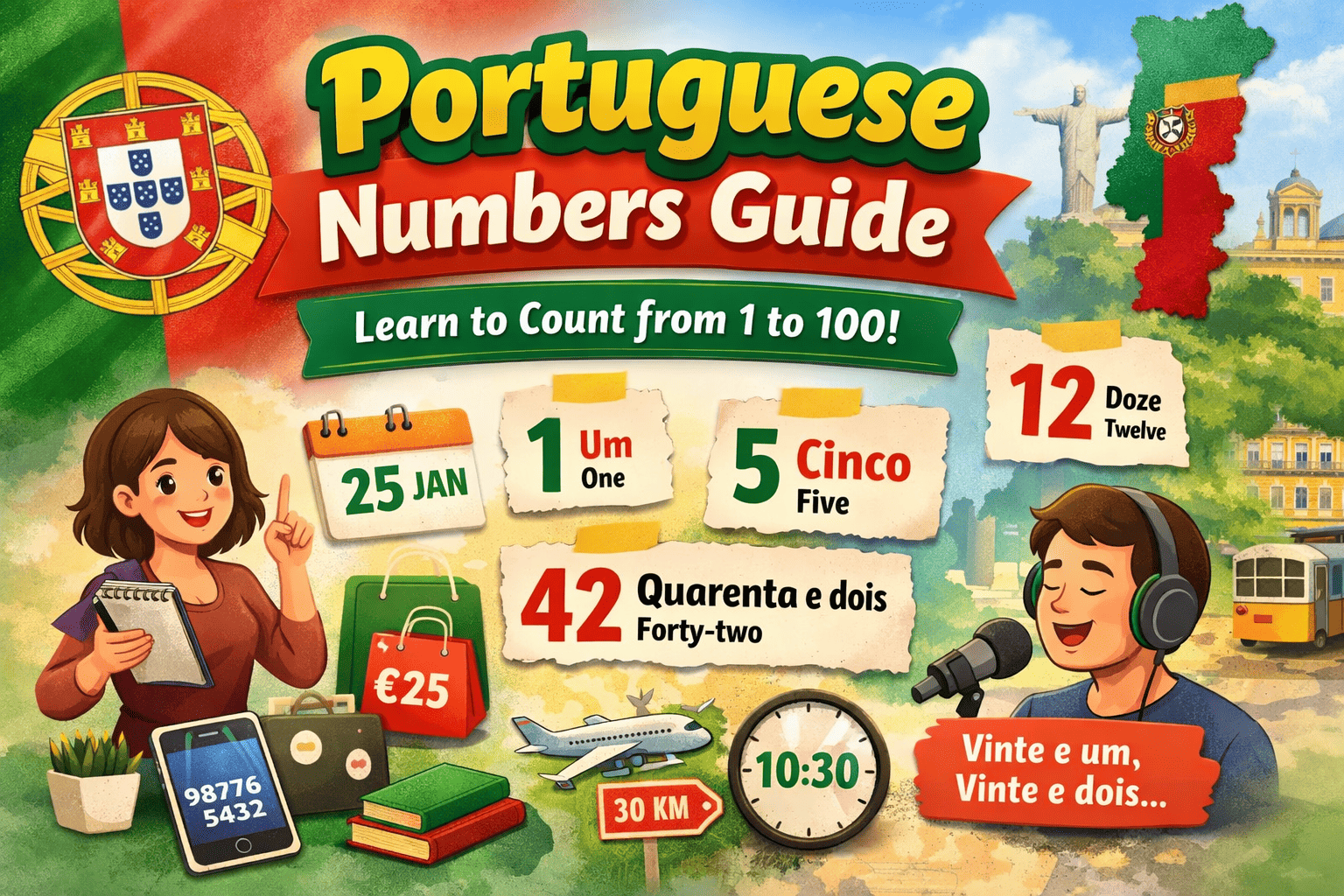
Learning Portuguese number is first step for anyone who starting to learn the language because number are used every day – shopping, travel, work and exams. Whether you are asking for prices, sharing your phone number or talking about dates and age, numbers appear constantly in real life communication.
Learning them early helps Portuguese learners to understand spoken language better with communication clearly. This guide help beginners to learn Portuguese language numbers clearly and use them naturally in real life situations.
Just like English numerals, Portuguese language also has numerals for written or spoken symbols that used to represent number in Portuguese language. While the other word number usually refers to value themselves (1,2,3), numerals describe how those numbers are written or spoken in Portuguese.
In Portuguese numerals include number name like um(one), dois(two), três(three), along with the system used to count, read and say number correctly in Portuguese.
Portuguese numbers does uses the Indo – Arabic numeral system (0-9) just like English number system. This means the way numbers are written is familiar, but the pronunciation and spelling are quite different that sounds may sound unfamiliar to portuguese learning beginners.
This is friendly for early leaners who just started learning Portuguese language.
| Number | Portuguese | English | Examples |
| 1 | um | one | Tenho um livro |
| 2 | dois | two | Dois amigo. (Two friends.) |
| 3 | três | three | Três dias (three days) |
| 4 | quatro | four | Quatro horas (Four hours) |
| 5 | cinco | five | Cinco minutos (five minutes) |
| 6 | seis | six | Seis anos. (six years) |
| 7 | sete | Seven | Sete pessoas. (seven people) |
| 8 | oito | eight | Oito lugares. (Eight places.) |
| 9 | nove | nine | Nove livros. (Nine books.) |
| 10 | dez | ten | Dez reais. (Ten reais.) |
| 11 | onze | eleven | Onze alunos. (Eleven students.) |
| 12 | doze | twelve | Doze meses. (Twelve months.) |
| 13 | treze | thirteen | Treze páginas. (Thirteen pages.) |
| 14 | catorze | fourteen | Catorze dias.(Fourteen days.) |
| 15 | quinze | fifteen | Quinze minutos. (Fifteen minutes.) |
| 16 | dezesseis | sixteen | Dezesseis anos.(Sixteen years.) |
| 17 | dezessete | seventeen | Dezessete pessoas. (Seventeen people.) |
| 18 | dezoito | eighteen | Dezoito livros.(Eighteen books.) |
| 19 | dezenove | nineteen | Denenove casas. (Nineteen houses.) |
| 20 | vinte | twenty | Vinte reais. (Twenty reais.) |
Once you understand basic Portuguese numbers from 1 to 20, counting from 21 to 100 becomes easier because number follow use simple and logical patterns, most numbers are formed by combining these tens with units.
In Portuguese number system it uses the word “e” (and) to connect numbers.
Structure for number
Tens + e + units
Examples:
Portuguese tens (20-90)
| Numbers | Portuguese | English |
| 20 | vinte | Twenty |
| 30 | trinta | Thirty |
| 40 | quarenta | Forty |
| 50 | cinquenta | Fifty |
| 60 | sessenta | Sixty |
| 70 | setenta | Seventy |
| 80 | oitenta | Eighty |
| 90 | noventa | Ninety |
Number 100 in Portuguese – cem (used alone) just like hundred in English.
Point to note – when we use 100 (cem) with other number, cem changes to cento (e.g., cento e um – 101)
Portuguese numbers system is divided into two parts cardinal numbers and ordinal numbers. This is important for beginner to understand difference between these two which help them to use numbers correctly in daily conversations.
Cardinal numbers only used for count things and measure quantity. They answer the question “how many?”
Common uses include:
Examples:
For showing things in order or position in sequence, ordinal numbers are used and you can use ordinal number to answer questions like “which one?” or “in what order?” rather than “how many”.
Common uses include:
Examples:
Once you start learning Portuguese, number appear in many times in everyday situations. What you need it understand how to use them correctly to sound natural while communicating in english.
Common ways to use numbers:
We have prepared a list of common mistake that every beginner often make and this challeneges feels hard while learning portuguese number, being aware of these mistkes help you to avoid them.
Learning portuguese number becomes easier when you approach it with regular practice and right guidance instead of memorizing lists, focus on using numbers in real situations.
Here are tips that you can follow for faster learning:
Learning not only portuguese number but whole language learning become easy when you follow a strucutred and pratical approach. Linguapol help portuguese learners to understand number not just in theory, but in real life usage through guided lessons and clear explanations.
Learning language required a complete environment, where some people lack and find difficulty while learning portuguese language online. But through online classes you can only understand some basic of protuguese, while learning spoken portuguese language require guided instructor to clear structure and correct pronunciation.
Linguapol offer a practical learning approach that help beginners that build a strong foundation in portuguse language. With experts guidance with year of experience in teaching portugese help you to become fluent speaker in portuguese.
No, even it is easy just like english number system which has follow clear patterns but beginner feels in challenging because of unfamiliar words rules.
Yes, both language carry few numbers may vary slightly diffrence in pronunciation, but the counting systems remain same.
Just in fews days, after understanding the some number rules clearly and building some basic number understanding from 1 to 100.
1 to 10 in portuguese are: um, dois, três, quatro, cinco, seis, sete, oito, nove, dez.
Correct pronuciation give clear understanding of numbers that help to quantify and measuring things in more accurate way.
It depends on the noun they describe just like um/uma and dois/ duas change based on gender, depending on noun they describe.

Instructor: Mrs Raka Adhikari

Lectures: 42

Duration: 12 Weeks

Enrolled: 20 Students

Language: Portuguese
Medium of Instruction: English & Hindi

To keep up with this era of fast-paced globalization, the one skill that remains timeless is learning languages. It continues to be one of the most highly-paid career paths available. So if you are seeking a 100% placement guarantee, just indulge with us in a world full of foreign languages.
CIN - U85500DL2024NPL433420
ISO - 9001-2015