
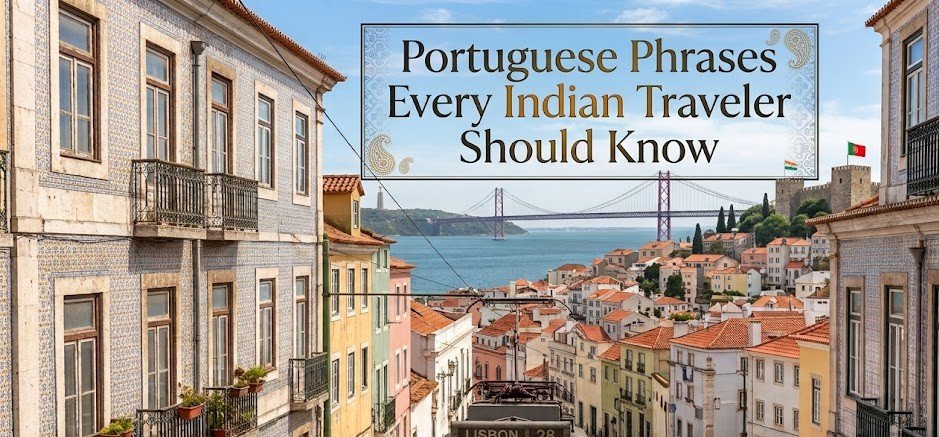
Portugal is one of the most welcoming destinations in Europe. English is spoken widely in Lisbon, Porto, and most tourist areas. But knowing even twenty to thirty phrases in Portuguese changes your experience entirely. Locals warm to visitors who make the effort. Menus become readable. Directions become manageable. Conversations that would otherwise need Google Translate happen directly.
This guide covers the practical phrases Indian travellers need most, organised by situation: airports, transport, hotels, restaurants, shopping, directions, and emergencies. All phrases are in European Portuguese, which is what is spoken in Portugal.
Brazilian Portuguese note: Some words differ between Portugal and Brazil. "Train" in Portugal is "comboio," in Brazil it is "trem." "Bus" in Portugal is "autocarro," in Brazil it is "onibus." "Breakfast" in Portugal is "pequeno-almoco," in Brazil it is "cafe da manha." The phrases in this guide use European Portuguese throughout.
Keep this as your go-to reference before and during your trip.
| Portuguese Phrase | English Meaning | Pronunciation Guide | When to Use |
| Ola! | Hello! | OH-lah | Universal greeting |
| Bom dia | Good morning | bom JEE-ah | Until around noon |
| Boa tarde | Good afternoon | BOH-ah TAR-deh | Afternoon to early evening |
| Boa noite | Good evening / Good night | BOH-ah NOY-teh | Evening |
| Por favor | Please | poor fah-VOR | Any polite request |
| Obrigado (m) / Obrigada (f) | Thank you | oh-bree-GAH-doo / oh-bree-GAH-dah | After any help or service |
| De nada | You're welcome | deh NAH-dah | Response to thank you |
| Desculpe | Sorry / Excuse me | desh-KOO-peh | Apologising or getting attention |
| Com licenca | Excuse me | kom lee-SEN-sah | Getting past someone, formal requests |
| Faz favor | Excuse me / Please | fash fah-VOR | Calling a waiter's attention |
| Sim | Yes | seem | Agreement |
| Nao | No | nowm | Refusal or negation |
| Nao percebo | I don't understand | nowm pair-SEH-boo | When something is unclear |
| Fala ingles? | Do you speak English? | FAH-lah een-GLAYSH? | Asking for English assistance |
| Onde e...? | Where is...? | ON-deh eh? | Asking directions |
| Quanto custa? | How much does it cost? | KWAN-too KOOSH-tah? | Shopping or transport |
| A conta, por favor | The bill, please | ah KON-tah, poor fah-VOR | Restaurants |
| Preciso de ajuda | I need help | preh-SEE-zoo deh ah-ZHOO-dah | Asking for assistance |
| Sou vegetariano/a | I am vegetarian | soh veh-zheh-tah-ree-AH-noo/nah | Restaurants |
| Sem carne, sem peixe | Without meat, without fish | seng KAR-neh, seng PAY-sheh | Ordering food |
| Tenho uma reserva | I have a reservation | TEN-yoo OO-mah reh-ZER-vah | Hotel check-in |
| Pode ajudar-me? | Can you help me? | POH-deh ah-zhoo-DAR-meh? | Asking for assistance |
| E longe? | Is it far? | eh LON-zheh? | Directions |
| Chame a policia! | Call the police! | SHA-meh ah poh-LEE-see-ah | Emergency |
| Chame um medico! | Call a doctor! | SHA-meh oong MEH-dee-koo | Emergency |
| Ate logo | See you later / Goodbye | ah-TEH LOH-goo | Saying goodbye |
| Ate ja | See you soon | ah-TEH ZHAH | Informal goodbye |
| Esta delicioso! | It's delicious! | esh-TAH deh-lee-see-OH-zoo | Complimenting food |
| Tem Wi-Fi? | Do you have Wi-Fi? | teng wee-fee? | Hotels and cafes |
| Posso pagar com cartao? | Can I pay by card? | POH-soo pah-GAR kom kar-TOWNG? | Shopping and restaurants |
Portugal has good rail and bus connections. In Lisbon, the Metro is the easiest way to get around. In Porto, both Metro and tram are used. Here are the most useful phrases.
| Portuguese | English | Notes |
| Onde e a estacao de comboio? | Where is the train station? | "Comboio" = train (European Portuguese) |
| Onde e a paragem do autocarro? | Where is the bus stop? | "Autocarro" = bus (European Portuguese) |
| Quanto custa um bilhete para...? | How much is a ticket to...? | Add destination name at the end |
| A que horas parte o comboio? | What time does the train leave? | Useful for intercity travel |
| Quero ir para... | I want to go to... | Add destination name |
| Preciso de um taxi | I need a taxi | Also useful for ride-hailing services |
| Onde posso apanhar o Metro? | Where can I take the Metro? | Lisbon and Porto both have Metro systems |
Most hotel staff in Portugal speak English, particularly in Lisbon and Porto. These phrases are useful in smaller towns and guesthouses, and they always make a good impression.
| Portuguese | English | Notes |
| Tenho uma reserva | I have a reservation | Have your booking reference ready |
| O meu nome e... | My name is... | Add your name |
| Onde e o meu quarto? | Where is my room? | Also useful: "Onde e o elevador?" (Where is the lift?) |
| A que horas e o pequeno-almoco? | What time is breakfast? | "Pequeno-almoco" = breakfast (European Portuguese) |
| Tem Wi-Fi? | Do you have Wi-Fi? | Very commonly needed |
| Qual e a senha do Wi-Fi? | What is the Wi-Fi password? | Follow-up if yes |
| A que horas e o check-out? | What time is check-out? | Standard across the industry |
| Preciso de ajuda com a bagagem | I need help with my luggage | Polite way to ask for a porter |
This is where preparation matters most for Indian travellers. Portugal has a meat and seafood-heavy food culture. Vegetarian options exist but are limited, particularly outside major cities. Always communicate your requirements clearly.
| Portuguese | English | Notes |
| Uma mesa para... pessoas, por favor | A table for... people, please | Add number of people |
| O que recomenda? | What do you recommend? | Good conversation opener |
| Sou vegetariano / Sou vegetariana | I am vegetarian (m/f) | Men say "-iano," women say "-iana" |
| Nao como carne | I don't eat meat | Clear and direct |
| Nao como peixe | I don't eat fish | Important: many "vegetarian" dishes in Portugal contain fish |
| Sem carne e sem peixe, por favor | Without meat and without fish, please | Most useful combination for Indian vegetarians |
| Tem opcoes vegetarianas? | Do you have vegetarian options? | Ask in advance |
| Isto tem carne? | Does this contain meat? | Use when unsure about a dish |
| Faz favor! | Excuse me! | To call the waiter's attention |
| A conta, por favor | The bill, please | Standard for requesting the bill |
| Esta delicioso! | It's delicious! | Always appreciated |
Couvert reminder: Many restaurants in Portugal place bread, olives, or cheese on your table automatically. This is the "couvert" and it is charged separately on your bill. Ask to have it removed if you do not want it: "Pode levar, por favor?" (Can you take it away, please?)
| Portuguese | English | Notes |
| Quanto custa isto? | How much does this cost? | Point to the item if needed |
| Tem noutro tamanho? | Do you have this in another size? | Clothing and shoes |
| Posso experimentar? | Can I try this on? | Fitting rooms |
| Posso pagar com cartao? | Can I pay by card? | Cards widely accepted in Portugal |
| Tem uma opcao mais barata? | Do you have a cheaper option? | Polite way to ask |
| Quero comprar isto | I would like to buy this | Clear buying signal |
| Tem desconto? | Is there a discount? | Worth asking at markets |
| Portuguese | English | Notes |
| Onde e...? | Where is...? | Add place name after "e" |
| Como posso chegar a...? | How can I get to...? | Add destination after "a" |
| E longe? | Is it far? | Simple yes/no question |
| Pode mostrar-me no mapa? | Can you show me on the map? | Useful when directions are complex |
| Vire a esquerda / direita | Turn left / right | Left = esquerda, Right = direita |
| Em frente | Straight ahead | Key direction word |
| Fica perto? | Is it nearby? | Alternative to "E longe?" |
Keep these memorised or saved on your phone.
| Portuguese | English |
| Preciso de ajuda! | I need help! |
| Chame a policia! | Call the police! |
| Chame um medico! | Call a doctor! |
| Onde e o hospital mais proximo? | Where is the nearest hospital? |
| Perdi o meu passaporte | I lost my passport |
| Perdi a minha carteira | I lost my wallet |
| Nao percebo portugues | I don't understand Portuguese |
| Fala ingles? | Do you speak English? |
Emergency number in Portugal: 112 (covers police, ambulance, and fire)
| Number | Portuguese | Pronunciation |
| 1 | um / uma | oong / OO-mah |
| 2 | dois / duas | doysh / DOO-ash |
| 3 | tres | traysh |
| 4 | quatro | KWAH-troo |
| 5 | cinco | SING-koo |
| 6 | seis | saysh |
| 7 | sete | SEH-teh |
| 8 | oito | OY-too |
| 9 | nove | NOH-veh |
| 10 | dez | desh |
| 11 | onze | ON-zeh |
| 12 | doze | DOH-zeh |
| 15 | quinze | KEEN-zeh |
| 20 | vinte | VEEN-teh |
| 50 | cinquenta | sin-KWEN-tah |
| 100 | cem | seng |
Useful combinations: "vinte e cinco" = 25, "cinquenta euros" = 50 euros, "quarto numero oito" = room number 8
European Portuguese pronunciation is distinct and takes some getting used to. Here are the patterns that trip up most Indian learners.
● Vowels get reduced or dropped. "Obrigado" often sounds like "bree-GAH-doo" in fast speech. The unstressed "o" at the start almost disappears.
● The letter "x" usually sounds like "sh." "Caixa" (cashier) sounds like "KAI-shah."
● "Lh" sounds like the "lh" in "million." "Elho" sounds like "EL-yoo."
● "Nh" sounds like the "ny" in "canyon." "Banho" (bath) sounds like "BAN-yoo."
● The nasal "ao" sounds like "owng." "Obrigacao" ends in "sowng" with a nasal quality.
● Unstressed "e" at the end of a word is often silent. "Tarde" (afternoon) sounds closer to "TAR-deh" but the final "e" is very reduced.
For deeper support with European Portuguese pronunciation, our Portuguese Pronunciation Guide walks through the key sounds with examples.
● Start with greetings and polite phrases. "Bom dia," "por favor," and "obrigado/a" are used constantly and always appreciated.
● Learn food phrases before you arrive. Communicating dietary requirements clearly is essential in Portugal if you are vegetarian. Practice "Sou vegetariano/a" and "Sem carne e sem peixe, por favor" until they feel automatic.
● Do not rely entirely on translation apps. Apps fail in noisy environments, when your phone battery is low, and in areas with poor signal. Ten memorised phrases outperform an app in a real emergency.
● Practice saying phrases aloud. Reading Portuguese and speaking it are different skills. Saying each phrase ten times out loud before your trip trains your mouth to produce sounds that English does not use.
● Learn numbers before prices. Knowing "vinte e cinco euros" (25 euros) stops you from guessing at prices and makes market interactions much easier.
A few memorised phrases will get you through most tourist interactions. But if you want to understand replies, hold a basic conversation, or travel with more confidence in less touristy areas, a short structured course before your trip makes a real difference.
Linguapol offers beginner Portuguese courses designed around practical, everyday communication. You can learn at your own pace with the support of experienced instructors who understand what new learners need most.
Explore the Portuguese language course at Linguapol and prepare for your trip with more than just a phrase list.
You do not need to be fluent to have a better experience in Portugal. Knowing thirty phrases, using them confidently, and being willing to try is enough to open conversations, show respect, and navigate most everyday situations without a translator.
Start with the cheat sheet at the top of this guide. Practice the food phrases if you are vegetarian. Save the emergency section on your phone. And say "Obrigado" or "Obrigada" every time someone helps you. Small things matter, and Portuguese people notice and appreciate the effort.
Not particularly at a basic travel level. Portuguese shares a large vocabulary with English through Latin roots, which makes many words recognisable. The pronunciation is the steepest challenge, especially European Portuguese, where unstressed vowels are often reduced or dropped and spoken Portuguese sounds quite different from written Portuguese. For travel purposes, learning thirty to fifty key phrases with their pronunciation takes most Indian learners only a few hours of focused practice.
Yes, English is widely spoken in major cities, tourist areas, hotels, airports, and restaurants in Lisbon, Porto, the Algarve, and most popular destinations. In smaller towns, rural areas, and among older generations, English proficiency is lower. Knowing basic Portuguese phrases gives you a practical safety net and makes a very positive impression regardless of whether the person you are speaking to also speaks English.
The most practical restaurant phrases are: "Faz favor!" (to call the waiter), "O que recomenda?" (what do you recommend?), "Sou vegetariano/a" (I am vegetarian), "Sem carne e sem peixe, por favor" (without meat and without fish), "A conta, por favor" (the bill please), and "Posso pagar com cartao?" (can I pay by card?). For Indian travellers specifically, clearly stating "Nao como carne" (I don't eat meat) and "Nao como peixe" (I don't eat fish) separately is important, as some Portuguese dishes described as vegetarian contain fish or fish-based stock.
Men say "Obrigado" (oh-bree-GAH-doo) and women say "Obrigada" (oh-bree-GAH-dah). This gender distinction is based on the speaker, not the person being thanked. For a stronger expression, "Muito obrigado/a" means "Thank you very much." "De nada" (deh NAH-dah) is the standard response meaning "you're welcome."

Instructor: Mrs Raka Adhikari

Lectures: 42

Duration: 12 Weeks

Enrolled: 20 Students

Language: Portuguese
Medium of Instruction: English & Hindi

To keep up with this era of fast-paced globalization, the one skill that remains timeless is learning languages. It continues to be one of the most highly-paid career paths available. So if you are seeking a 100% placement guarantee, just indulge with us in a world full of foreign languages.
CIN - U85500DL2024NPL433420
ISO - 9001-2015