
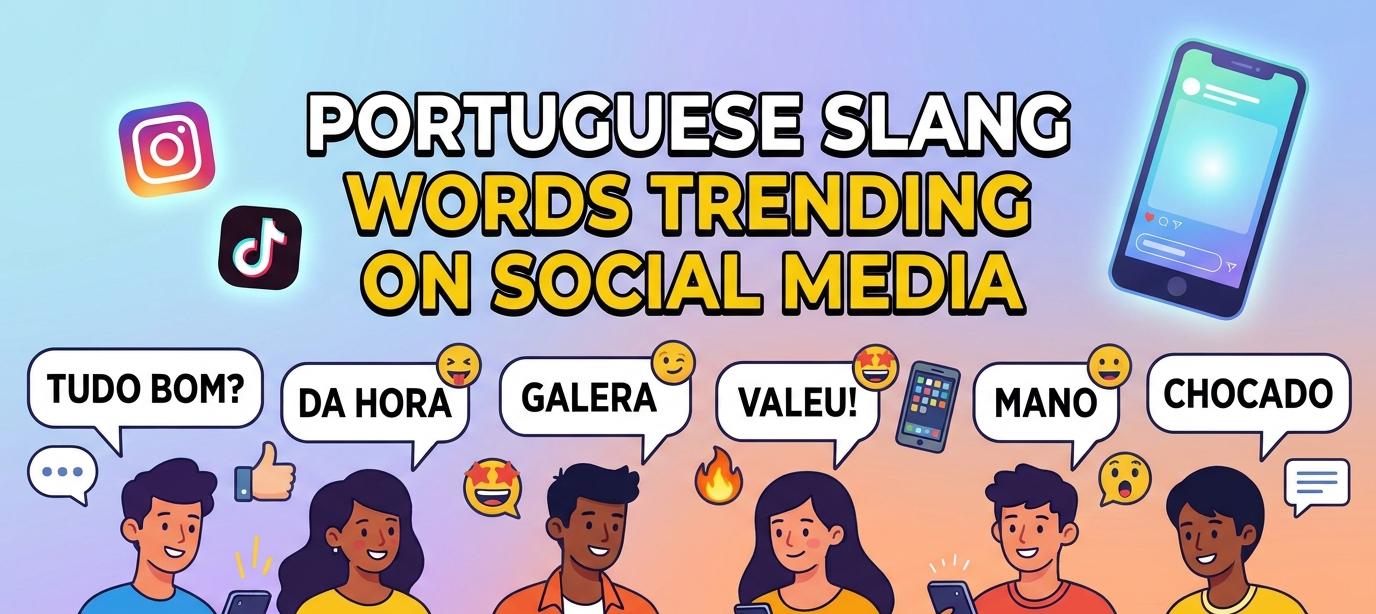
If you have ever scrolled through a Portuguese or Brazilian TikTok video, left a comment, or tried to understand a meme caption, you have probably come across words that no dictionary seems to explain. Portuguese social media, especially in Brazil, runs on a fast-moving vocabulary of slang, borrowed English terms, gaming language, and expressions that shift with each viral trend.
Understanding this vocabulary matters for two reasons. First, it helps you actually understand what people are saying online. Second, it shows you how the language lives and moves in real usage, which is more interesting and often more memorable than textbook examples.
This guide focuses primarily on Brazilian Portuguese internet slang, where social media usage is among the most active in the world. A dedicated section covers European Portuguese expressions as well. All terms included here are in consistent, verified use across Brazilian and Portuguese social media.
Note on variety: Brazilian Portuguese and European Portuguese differ significantly in vocabulary and pronunciation. Slang from one is not always understood or used in the other. Each section in this guide is labelled accordingly.
These expressions appear regularly in Brazilian Instagram comments, TikTok captions, WhatsApp groups, and online conversations.
| Slang | Meaning | Tone | Example in Context |
|---|---|---|---|
| Bora | Let's go / Let's do it | Casual, energetic | "Bora assistir esse video!" (Let's watch this video!) |
| Mano | Dude / Bro | Casual, friendly | "Mano, que video incrivel!" (Dude, what an incredible video!) |
| Cara | Guy / Dude (also: face) | Casual | "Esse cara e muito engracado." (This guy is really funny.) |
| Legal | Cool / Nice / Great | Casual, positive | "Que legal!" (How cool!) |
| Slay | To look or perform amazingly | Enthusiastic | "Ela slay demais nesse video." (She absolutely slays in this video.) |
| Flopar | To flop / to fail | Neutral to negative | "Esse post flopou total." (That post totally flopped.) |
| Hitar | To go viral / to blow up | Positive | "Esse som hitou na semana passada." (That sound blew up last week.) |
| Cringe | Cringeworthy / embarrassing | Mocking or affectionate | "Que cringe esse video." (What a cringe video.) |
| Shippar | To ship two people | Enthusiastic | "Eu shippo muito esse casal." (I ship this couple so much.) |
| Delulu | Delusional / unrealistically hopeful | Playful, self-deprecating | "Eu sei que sou delulu, mas quero acreditar." (I know I'm delusional but I want to believe.) |
| Contatinho | A casual romantic interest | Playful | "Meu contatinho curtiu minha foto." (My situationship liked my photo.) |
| Ranço | Deep irritation with someone | Informal | "Estou com ranco dessa musica agora." (I'm so over this song now.) |
| Biscoitar | To fish for compliments / to attention-seek | Slightly mocking | "Ele so biscoita no Instagram." (He just fishes for compliments on Instagram.) |
| Tankar | To not be able to handle something | Humorous | "Nao da pra tankar esse video." (I cannot handle this video.) |
| Nao aguento | I can't handle it / I'm dying | Exaggerated, humorous | "Nao aguento esse meme." (I am dying over this meme.) |
Brazilian TikTok has its own rhythm of commenting. These are the expressions that appear most consistently across viral content, comment sections, and Reels reactions.
"Esse sou eu" (That's me)
Used when someone sees content that perfectly describes their own situation. The equivalent of "this is literally me" in English comment culture.
Example posted under a video about someone staying up too late: "Esse sou eu toda noite." (That's me every night.)
"Nao aguento" (I can't / I'm dead)
Used to express that something is so funny, cute, or overwhelming that you cannot cope. Similar to "I'm screaming" or "I'm dead" in English-speaking social media.
Example: "Nao aguento esse gatinho, socorro." (I can't handle this kitten, send help.)
"Que fase" (What a phase / What a time)
Used when someone is going through something, either genuinely difficult or humorously mundane.
Example: "Acordei atrasado, comi errado, perdi o onibus. Que fase." (Woke up late, ate badly, missed the bus. What a time.)
"Rizz" (natural charisma / effortless charm)
Borrowed directly from English-language social media. Used widely in Brazilian comments to describe someone with natural charm or the ability to attract others without effort.
Example: "Esse cara tem rizz demais." (This guy has way too much rizz.)
"Main character" / "Energia de protagonista" (Main character energy)
Describing someone who moves through life as if they are the lead of a film, usually with a cinematic aesthetic. Widely used in lifestyle TikTok content.
Example: "Ela entra na sala com energia de protagonista." (She walks into the room with main character energy.)
"Sqn / Sqan" (So que nao, meaning "only that no")
A sarcastic expression used after a statement to completely undermine it. Similar to "said no one ever" or "just kidding, not really."
Example: "Adoro acordar cedo. Sqn." (I love waking up early. Said no one ever.)
"Pode crer / Pdc" (You bet / For sure / True that)
An agreement expression used in comments to validate what someone said.
Example: "A vida e curta demais. Pode crer." (Life is too short. You bet.)
Gag / Ficou gag (Shocked / speechless)
Used when something is so surprising or scandalous that it leaves you speechless. Widely used in celebrity gossip and reality show commentary on social media.
Example: "Eu fiquei completamente gag com essa noticia." (I was completely gagged by that news.)
Protagonista / Antagonista (Protagonist / Antagonist)
Reality show terms that have migrated entirely into everyday social media language. Someone described as "protagonista" is the likeable centre of attention; "antagonista" is the person everyone follows to criticise.
"Eu sou assim" (I'm just like this)
Used to justify behaviour without apology, typically in response to relatable content. It carries the same energy as "this is just how I am" posted under a meme.
"Misericordia" (Lord have mercy / Oh my goodness)
An exclamation of disbelief, shock, or exaggerated horror. Used both sincerely and for comic effect.
Example under a dramatic before/after video: "Misericordia, que transformacao!" (Lord have mercy, what a transformation!)
Aura / Farmar aura (Aura farming)
Describes doing something specifically to appear cool, mysterious, or impressive online, often in a performative or self-aware way.
Example: "Ele so fez aquilo pra farmar aura." (He only did that to farm aura.)
These appear in comments, WhatsApp messages, and social media captions constantly. Learning these makes Brazilian online content much easier to follow.
| Abbreviation | Full Form | Meaning |
|---|---|---|
| kkkk | (sound of laughter) | Hahaha / LOL (more K's = bigger laugh) |
| rs / rsrs | Risos | Mild laugh / Heh (slightly dated among Gen Z) |
| vc | Voce | You |
| tb / tbm | Tambem | Also / Too |
| pq | Porque / Por que | Because / Why |
| n | Nao | No / Not |
| vdd | Verdade | True / That's true |
| sdds | Saudades | Miss you / Longing |
| flw | Falou | Bye / See ya (literally "spoke") |
| bjs | Beijos | Kisses / xx |
| obg | Obrigado/a | Thank you |
| pf / pfv | Por favor | Please |
| fds | Fim de semana | Weekend |
| glr | Galera | The gang / Guys / Everyone |
| mn | Mano | Bro / Dude |
| sqn / sqan | So que nao | Said no one ever / Not really |
| pdc | Pode crer | You bet / For sure |
A note on "kkkk": In Brazilian Portuguese, the letter K is pronounced "kah." Typing "kkkk" mimics the sound of rapid, staccato laughter. The more K's, the harder the laugh. "KKKKKKKKK" in all caps means someone is in genuine hysterics. This has no connection to any other meaning of those letters in other contexts. It is entirely harmless and by far the most common way Brazilians express laughter in text.
While this article focuses primarily on Brazilian Portuguese, European Portuguese has its own distinct social media vocabulary. These are the most commonly encountered expressions.
| Expression | Meaning | Example |
|---|---|---|
| Fixe | Cool / Great | "Que video fixe!" (What a cool video!) |
| Bue | Very / A lot (Lisbon youth slang) | "Isso foi bue engracado." (That was really funny.) |
| Ganda | Huge / Great / Awesome | "Ganda concerto ontem!" (Huge concert yesterday!) |
| Ma | Wow / No way (mild shock) | "Ma, nao acredito." (No way, I don't believe it.) |
| Epico | Epic | "Isso foi mesmo epico." (That was actually epic.) |
| Nao aguento | I can't handle it | Used in Portugal with the same meaning as in Brazil |
| Que saudades! | I miss this so much! | Common reaction to throwback or nostalgic content |
European Portuguese online culture also borrows heavily from English social media vocabulary. "Cringe," "vibe," "slay," and "rizz" appear in Portuguese comment sections in exactly the same form as in English.
| Concept | Brazilian Portuguese | European Portuguese |
|---|---|---|
| Cool / Great | "Legal" / "Massa" | "Fixe" / "Ganda" |
| Very / A lot | "Muito" / "Demais" | "Bue" / "Muito" |
| Dude / Bro | "Mano" / "Cara" | "Mano" / "Tipo" |
| Mild shock | "Misericordia" / "Gente" | "Ma" / "Epa" |
| Awesome / Epic | "Irado" / "Incrivel" | "Epico" / "Fixe" |
| Bye (casual text) | "Flw" / "Ate mais" | "Ate ja" / "Tchau" |
Both varieties share growing overlap in English-origin internet vocabulary. Words like "cringe," "ship," "slay," "delulu," and "flopar" are used across both countries in similar ways.
Slang carries register and context. Using it incorrectly can sound awkward. Here is how to approach it as a learner.
Understand the register first. Most of these words are informal and appropriate for comments, messages, and casual captions. They are not appropriate in academic writing, formal emails, or professional settings.
Match your audience. Brazilian slang is not always immediately understood in Portugal, and European expressions can sound out of place in Brazilian contexts. Match your expression to the community you are engaging with.
Use reactions proportionally. Typing a long string of K's under every comment when you are just starting out can feel inauthentic. React the way you would naturally in your own language, calibrated to the content.
Build vocabulary through exposure, not lists. Social media slang sticks best when you encounter it in context, understand it, and then see it again. Watching Brazilian or Portuguese creators on TikTok and YouTube builds this kind of natural familiarity far more effectively than memorising a word list.
Ready to move beyond slang and build structured Portuguese skills? Explore the Portuguese language course at Linguapol for a programme that takes you from beginner to confident speaker.
Understanding memes and comment sections is a genuinely useful entry point into any language. But slang alone does not build the grammar, pronunciation, or vocabulary depth needed for real conversations, academic study, or work in a Portuguese-speaking environment.
Linguapol offers beginner-friendly Portuguese courses built around practical, everyday communication. Whether your goal is understanding online content, preparing for life in Portugal, or developing professional Portuguese skills, a structured course builds that foundation significantly faster than self-study alone.
Explore the Portuguese language course at Linguapol and start building real language skills alongside your social media vocabulary.
Portuguese social media, particularly in Brazil, runs on a vocabulary that no standard dictionary fully captures. The slang, abbreviations, and meme expressions in this guide represent the core of what appears consistently across TikTok, Instagram, and everyday online conversations. Some of it is adapted from English internet culture. Some of it is entirely native. All of it tells you something real about how the language lives in the hands of the people who speak it.
Start with the abbreviations table and the reaction expressions. Then pay attention when you see them appearing in real content. That combination of structured recognition and genuine exposure is how these words move from a list you studied to language you actually understand.
Among the most widely used Brazilian Portuguese expressions on Instagram are "kkkk" (laughter), "nao aguento" (I can't handle it), "esse sou eu" (that's me), "slay" (used directly in Portuguese-language captions), "flopar" (to flop), and "shippar" (to ship). Abbreviations like "tbm" (also), "vc" (you), "bjs" (kisses), and "obg" (thank you) appear constantly in comment sections. In European Portuguese Instagram content, "fixe" (cool), "bue" (very), and "ganda" (great) are commonly seen.
"Kkkk" is the standard way Brazilians write laughter in text. The letter K in Portuguese is pronounced "kah," so typing "kkkk" mimics the sound of rapid laughter. More K's mean louder or more genuine laughter, and "KKKKKKKK" in all caps indicates genuine hysterics. It is the Brazilian equivalent of "lol," "hahaha," or "lmao" in English. The older form "rs" (from "risos," meaning laughs) is still used but tends to feel slightly dated to younger Brazilian social media users.
The most established Brazilian internet slang words include: "bora" (let's go), "mano" (dude/bro), "legal" (cool), "flopar" (to flop or get no engagement), "hitar" (to go viral), "ranço" (deep irritation with someone), "biscoitar" (to fish for compliments), "sqn" (said no one ever), "pdc" (you bet/for sure), and "nao aguento" (I can't handle it). Words borrowed from English, such as "cringe," "slay," "shippar," and "delulu," are also extremely common across Brazilian social media.
Not always. Some expressions overlap, but Brazilian and European Portuguese slang often differ significantly. "Legal" and "massa" are common in Brazil for "cool," while "fixe" and "ganda" are used in Portugal. "Bue," meaning "very" or "a lot," is a distinctly European Portuguese expression not commonly used in Brazil. Both countries increasingly share English-origin internet terms like "cringe," "slay," and "rizz" in the same form. "Kkkk" for laughter is understood in both countries, though it originates in Brazilian digital culture.
The most effective approach combines passive exposure with active learning. Follow Brazilian and Portuguese creators on TikTok, YouTube, and Instagram in your areas of interest. Watch content without subtitles first, then check with subtitles for comprehension. Note new words and expressions in context rather than in isolation. Pay attention to abbreviations and slang as you encounter them naturally in comment sections. For pronunciation, grammar, and vocabulary depth, a structured course alongside social media exposure is more effective than either approach alone. Explore the Portuguese language course at Linguapol for a programme that builds practical language skills from beginner level.

Instructor: Mrs Raka Adhikari

Lectures: 42

Duration: 12 Weeks

Enrolled: 20 Students

Language: Portuguese
Medium of Instruction: English & Hindi

To keep up with this era of fast-paced globalization, the one skill that remains timeless is learning languages. It continues to be one of the most highly-paid career paths available. So if you are seeking a 100% placement guarantee, just indulge with us in a world full of foreign languages.
CIN - U85500DL2024NPL433420
ISO - 9001-2015