
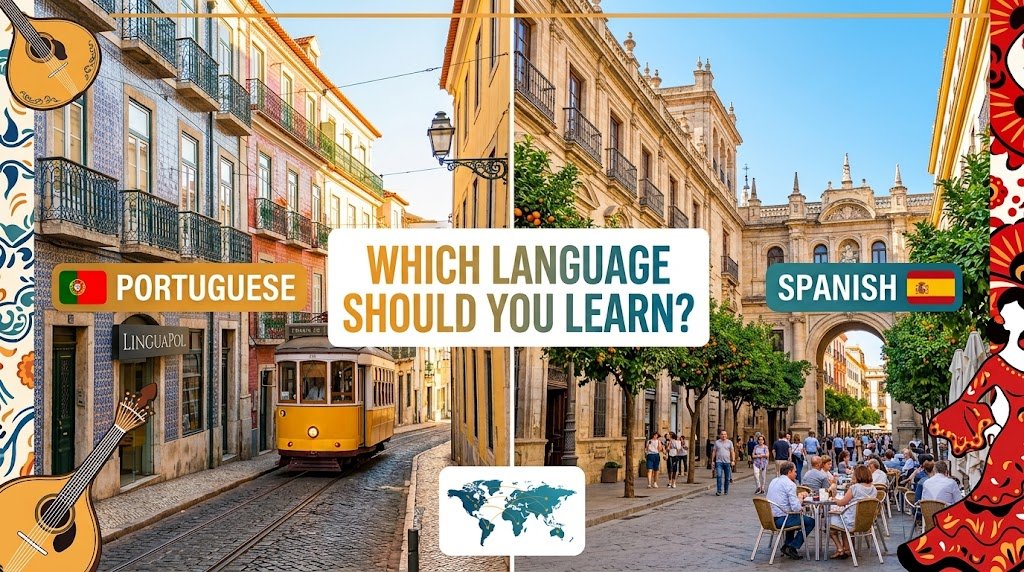
Both Portuguese and Spanish are popular choices for learners who want to add a foreign language to their skillset. They come from the same language family, share a large part of their vocabulary, and are spoken across some of the world's most active economies.
But they are not the same language. And the right choice depends entirely on what you want to do with it.
This article breaks down the key differences between Portuguese and Spanish, covers which is easier to learn, and helps you decide which one fits your career goals better, especially if you are a student or working professional in India.
One of the most common questions learners ask is whether Portuguese and Spanish are interchangeable. They are not. Both come from Latin and share a significant amount of vocabulary. However, they differ in pronunciation, grammar patterns, and usage in ways that matter when you start learning.
Here is a side-by-side comparison:
| Category | Portuguese | Spanish |
|---|---|---|
| Native Speakers | ~260 million | ~485 million |
| Official Countries | 9 | 20+ |
| Key Markets | Brazil, Portugal, Angola, Mozambique | Spain, Mexico, Colombia, Argentina |
| Pronunciation | Nasal vowels, reduced sounds in European variety | Phonetic, consistent vowel sounds |
| Shared Vocabulary | ~89% lexical similarity | ~89% lexical similarity |
| Learning Difficulty (English speakers) | FSI Category I: 600-750 hours | FSI Category I: 600-750 hours |
| BPO / IT Demand in India | Growing, Brazil-focused | Moderate |
| Career Focus | Brazil, EU via Portugal, Lusophone Africa | Latin America, Spain, US Hispanic market |
Many words in Portuguese and Spanish look almost the same on paper but sound quite different when spoken aloud.
For example:
"Trabalho" (Portuguese) and "trabajo" (Spanish) both mean "work."
"Família" and "familia" both mean "family."
"Importante" means "important" in both languages.
This overlap is real and significant. Someone who knows Spanish can often read basic Portuguese text and pick up the general meaning. But listening to spoken Portuguese, especially the European variety, is a different experience entirely.
Spanish is largely phonetic. Words are pronounced close to how they are spelled, which makes it easier for beginners to start speaking with some confidence.
Portuguese uses nasal vowels and, in its European form, reduces or swallows many vowel sounds. "Obrigado" (thank you) sounds very different from how it looks on paper. Brazilian Portuguese is generally considered easier to follow for new learners because the vowels are more open and the rhythm is steadier.
If clear pronunciation at the beginning of your learning journey matters to you, Spanish has a slight edge. If you are drawn to the sound of Brazilian Portuguese, that ease of listening can motivate you to keep going.
The Foreign Service Institute (FSI) places both Portuguese and Spanish in Category I for English speakers. That means both require approximately 600 to 750 hours of study to reach professional working proficiency. On paper, they are equally challenging.
In practice, there are differences that affect how learners experience the early stages:
Spanish tends to feel easier at the start because:
Pronunciation rules are more consistent and predictable
More beginner resources are available in English
The phonetic structure is more accessible for non-native speakers
Portuguese has its own advantages:
Brazilian Portuguese has a musical, open sound that many learners find enjoyable
If you already know some Spanish, Portuguese becomes noticeably easier to grasp
The grammar, while similar to Spanish, has some structures that feel logical to English speakers
For Indian learners, neither language is close to Hindi, Tamil, or other regional languages in structure. Both require a genuine learning commitment. The difference in difficulty is not large enough to make it the main reason for choosing one over the other.
Portuguese language jobs are concentrated around Brazil, Portugal, and Portuguese-speaking African countries. In India, demand is growing in:
BPO and customer support serving Brazilian clients
International trade between India and Brazil or Portugal
Translation and localisation for Portuguese content
IT and technology roles at companies with Brazilian operations
Brazil is the largest economy in Latin America. According to World Bank data on Brazil, it ranks among the largest economies globally by GDP. For professionals weighing Portuguese vs Spanish for jobs, Portuguese offers a less crowded field because fewer candidates in India currently hold the skill.
Spanish is the official language in more than 20 countries. For Indian professionals, Spanish creates opportunities in:
BPO and customer support for Spanish-speaking clients
Tourism and hospitality serving Spanish-speaking travellers
Content, translation, and localisation for Spanish markets
Export-oriented businesses dealing with Spain and Latin America
Spanish has more speakers and a broader geographic reach. However, more candidates are trained in Spanish, which means competition for language roles is also higher.
Both languages offer genuine portuguese language career opportunities or Spanish career paths depending on your target industry. The real difference is competitive density.
Spanish is in higher overall demand, but more candidates supply it. Portuguese is in strong demand for specific roles, with fewer trained professionals available to fill them. If a company needs someone who can manage Brazilian client relationships and you are the only candidate with Portuguese, that specific gap works in your favour.
For most Indian learners, the choice comes down to career goal, target market, and learning commitment.
You want to work in BPO, customer support, or international trade focused on Brazil
You are targeting a role at a company with operations in Brazil, Portugal, or Lusophone Africa
You want to study or work in Portugal, which is part of the European Union
You prefer a less common skill that gives you a clearer differentiator when applying for language roles
You are interested in exploring Portuguese language courses that focus on workplace communication
You want access to the widest possible range of Spanish-speaking markets
You are interested in tourism, hospitality, or content roles across Latin America
You want a language with more widely available self-study resources
You are building a general multilingual profile with a broadly recognised language
Both paths are practical. The question is which one connects more directly to where you want to take your career.
There is no universally correct answer. What matters is matching the language to your goals.
Portuguese makes more sense if Brazil, Portugal, or Lusophone Africa are relevant to your career or study plans, and if you want a skill that is genuinely in demand but less crowded among Indian language professionals.
Spanish makes more sense if you want broader Latin American market access or are drawn to industries where Spanish coverage across 20+ countries is an asset.
If you are unsure, a useful approach is to look at the industries and companies you want to work for, check what language skills appear in their job descriptions, and let that guide the decision. That is more reliable than choosing based on which language sounds more familiar or popular.
For learners leaning toward Portuguese, it is also worth reading about portuguese language jobs and career opportunities to understand the specific roles where it adds value.
The difference between Portuguese and Spanish is real, but the two languages are close enough that experience in one can help you later with the other.
Both sit in the same difficulty range for English and Indian language speakers. Both offer career paths in translation, BPO, international business, and tourism. Both require consistent practice and a structured learning approach to reach a level that is useful at work.
What matters most is choosing the language that aligns with the markets you want to work in and the roles you are actually targeting.
If Portugal, Brazil, or Lusophone Africa are part of your professional picture, Portuguese is worth a focused look. If you want the widest possible coverage across Spanish-speaking countries, Spanish may be your starting point.
To explore structured Portuguese language courses designed around real career communication, contact Linguapol for course information and find a format that works for your schedule.
Both languages are useful depending on the industry you are targeting. Spanish has wider global coverage, but Portuguese is in growing demand for BPO roles, IT services, and international trade connected to Brazil and Portugal. For roles that specifically require Brazilian market communication, Portuguese gives Indian professionals a clearer competitive edge because fewer candidates hold that skill.
Partially. Portuguese and Spanish share approximately 89% lexical similarity, which means speakers of one language can often read basic content in the other. However, spoken understanding is considerably harder, particularly with European Portuguese. Without specific training in the other language, a Spanish speaker cannot reliably hold a conversation in Portuguese, and vice versa.
Spanish covers more countries and has a larger speaker base, which creates a wider overall job market. Portuguese has fewer trained professionals available relative to its demand in specific industries, particularly for Brazilian market roles. This means Portuguese can offer a stronger competitive advantage in targeted hiring situations, while Spanish provides broader general access across more markets.
If your career goals point toward Brazil, Portugal, or Portuguese-speaking African countries, start with Portuguese. If you want access to Latin America broadly or markets across 20+ Spanish-speaking countries, start with Spanish. For complete beginners, Spanish pronunciation is slightly more consistent and may feel easier to navigate at the very start. That said, if you already know some Spanish, picking up Portuguese later becomes significantly faster.

Instructor: Mrs Raka Adhikari

Lectures: 42

Duration: 12 Weeks

Enrolled: 20 Students

Language: Portuguese
Medium of Instruction: English & Hindi

To keep up with this era of fast-paced globalization, the one skill that remains timeless is learning languages. It continues to be one of the most highly-paid career paths available. So if you are seeking a 100% placement guarantee, just indulge with us in a world full of foreign languages.
CIN - U85500DL2024NPL433420
ISO - 9001-2015