
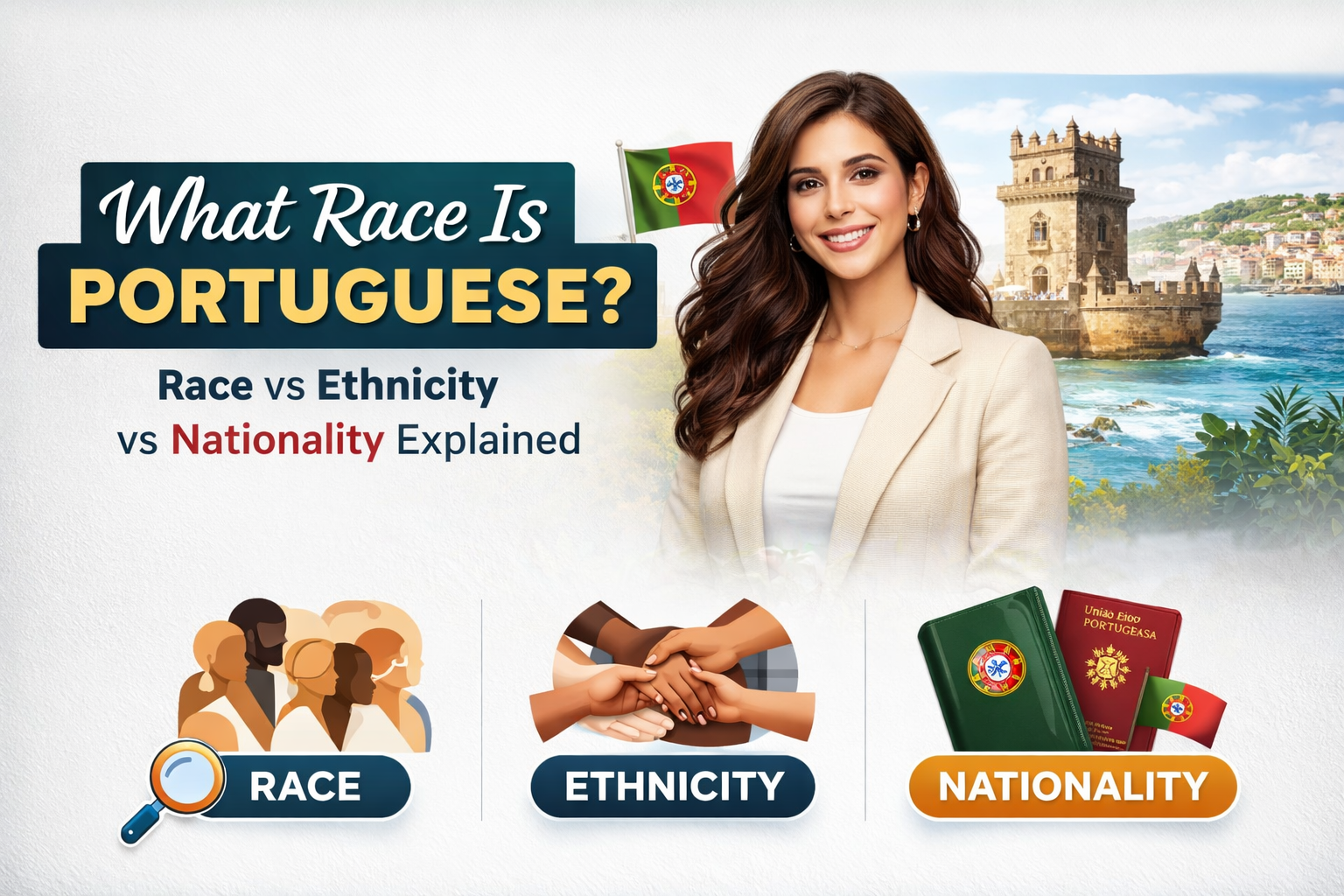
What race is Portuguese? and What ethnicity are Portuguese? These are the most common questions regarding southern European identity because the terms race and ethnicity are often used interchangeably and this can create confusion when trying to understand how Portuguese identity fits into these categories.
The answer is a bit complex. To understand Portuguese identity, we must investigate distinction between race, ethnicity and nationality because these differences, Portuguese identity is best to understood through its ethnic and cultural background connected to Portugal rather than a separate.
Portuguese identity is not a race. Race is a social construct which is used to categorize humans based on physical traits like skin color or bone structure. In global demographic system, people of Portuguese descent are racially categorized as white or Caucasian.
The term Portuguese usually refers to nationality or cultural identity connected to country of Portugal.
When someone identifies as Portuguese, it usually relates to:
· Nationality – being from or having citizenship in Portugal
· Ethnicity – sharing cultural traditions, heritage and ancestry
· Language – speaking Portuguese as native or heritage language
Race focuses on physical traits while ethnicity is heritage. The Portuguese ethnicity is defined by deep connection to the land of Portugal and about how Portuguese language is the set of traditions.
The Portuguese language is romance language and a direct descendant of Latin. It is the core of their identity which is separated from their neighbors. Roman Catholicism has also played a massive role in shaping the holidays, family structure and moral framework of the Portuguese people.
These two cultural elements that help to define Portuguese identity with fado music and the feeling know as saudade. Both are deeply connected to traditions and emotional expression found in Portugal.
“Fado” is traditional style Portuguese music that often expresses deep emotions such as nostalgia and love. This music typically performed with singer accompanied by Portuguese guitar.
While fado is the concept of “saudade”, a Portuguese word that describes a deep emotional state of longing or nostalgia for something or someone that may be absent which often described as a mixture of sadness, love and remembrance.
Together fado music and the feeling of saudade reflect an important part of portugal culture.
The cultural makeup of Portugal is a melting pot because of its location on the Atlantic coast of the Liberian peninsula.
There are some historical influences in the mainland of Portugal:
· The Lusitanians and Celts: These are the first people who inhabited the land before the Romans.
· The Romans: They are the given region with its language and legal foundation which we see today.
· The Visigoths and Suebi: Germanic tribes are the one who migrate in Portugal after the fall of Rome.
· The Moors: North African have very important impact on architecture, agriculture, and genetics in peninsula.
· The Age of Discovery: In15th and 16th centuries, Portugal became a global empire and it’s leading to further integration with populations from Africa, Asia, and South America.
People might confuse between Portuguese and Hispanic or Latino:
Those people who ask are Portuguese Hispanic? The clear answer is No, Portugal is its own nation with its own language, but Hispanic people come from Spanish countries and people come from Portugal speak Portuguese rather than Spanish.
· Language
· Country of origin
· Cultural development
No, People from Portugal is Portuguese and people from Latin America is Latino. Which means a person who can speak Portuguese don't mean that he came from Portugal, they often came from Brazil as well. You can say that people from Portugal is European.
| Term | Includes Portuguese? | Reason |
| Hispanic | No | Refers to Spanish-speaking origins. |
| Latino | Usually No | Refers to Latin American origins. |
| Lusophone | Yes | Refers specifically to Portuguese-speaking people/culture. |
Portuguese people originally come from Portugal but due to business purpose Portuguese travel all around the globe and today Portuguese communities live in many parts of the world. This global presence developed over centuries through migration, trade and exploration
One of the biggest reasons for this global presence that spread was Portugal's historical role in exploration and overseas expansion.
Major countries with Portuguese communities
· Brazil
Brazil was colonized by Portugal for more than three centuries and during this period, the Portuguese language spread throughout the region and eventually it becomes and eventually the dominating language of population.
· Angola
Angola is largest Portuguese speaking counties in Africa and has rapidly growing Portuguese speaking population. This part of Africa is ruled by Portugal empire, and Portuguese was used in administration, trade and education.
· Mozambique
In early 16th century Portuguese was used in government, trade and education and for 500 years Mozambique was controlled by Portugal and after independence from Portugal in 1975 the government kept Portuguese as official language.
For understanding culture, it's become important to learn about their language because language gives you a clear context about things. Its help you experience the traditions, values, and everyday life that connected in Portugal more deeply.
Learning Portuguese can help you understand culture in several ways;
· Deeper cultural understanding – you can understand better their traditions, social values, and historical influences.
· Stronger communication – speaking language allow you to interact more naturally with Portuguese speaking communities.
· Access to their cultural content – you can enjoy Portuguese books, music, films, and media in their original form.
In summary, the question “what race is Portuguese” often comes with complexity between race, ethnicity, and nationality. Portuguese is not a race, but rather than nationality and cultural identity that connected to country of Portugal.
Portuguese identity is shaped by many shared language, traditions, history and heritage. But over centuries, different historical influences helped form the culture that defined Portuguese people today because of migration and historical connections.
Are Portuguese people Hispanic?
No, Portuguese people are not considered Hispanic, but people sometime become confused because Portuguese and Hispanic culture share some similarities because they come from same region of Europe which have some sort of values.
What ethnicity are Portuguese people?
Portuguese people generally considered part of southern European ethnic group. Their ethnicity is connected with ancestry, language, and traditions.
Are Portuguese considered European?
Yes, Portuguese people are considered European because they come from the country of portugal, which is located to southwestern Europe on the Iberian Peninsula.
Where is Portuguese spoken around the world?
Portuguese spoken widely in the world. It is originated in Portugal but later spread globally through exploration, trade, and historical connection. Today Portuguese is official language in several countries, including Cape Verde, Angola, Brazil and Portugal.
Is Portuguese difficult to learn?
Portuguese is generally considered moderately difficult to learn but its level of difficulty depends on your native language and learning experience but those who have experience of other romans language they may find Portuguese vocab and grammar familiar

Instructor: Mrs Raka Adhikari

Lectures: 42

Duration: 12 Weeks

Enrolled: 20 Students

Language: Portuguese
Medium of Instruction: English & Hindi

To keep up with this era of fast-paced globalization, the one skill that remains timeless is learning languages. It continues to be one of the most highly-paid career paths available. So if you are seeking a 100% placement guarantee, just indulge with us in a world full of foreign languages.
CIN - U85500DL2024NPL433420
ISO - 9001-2015