
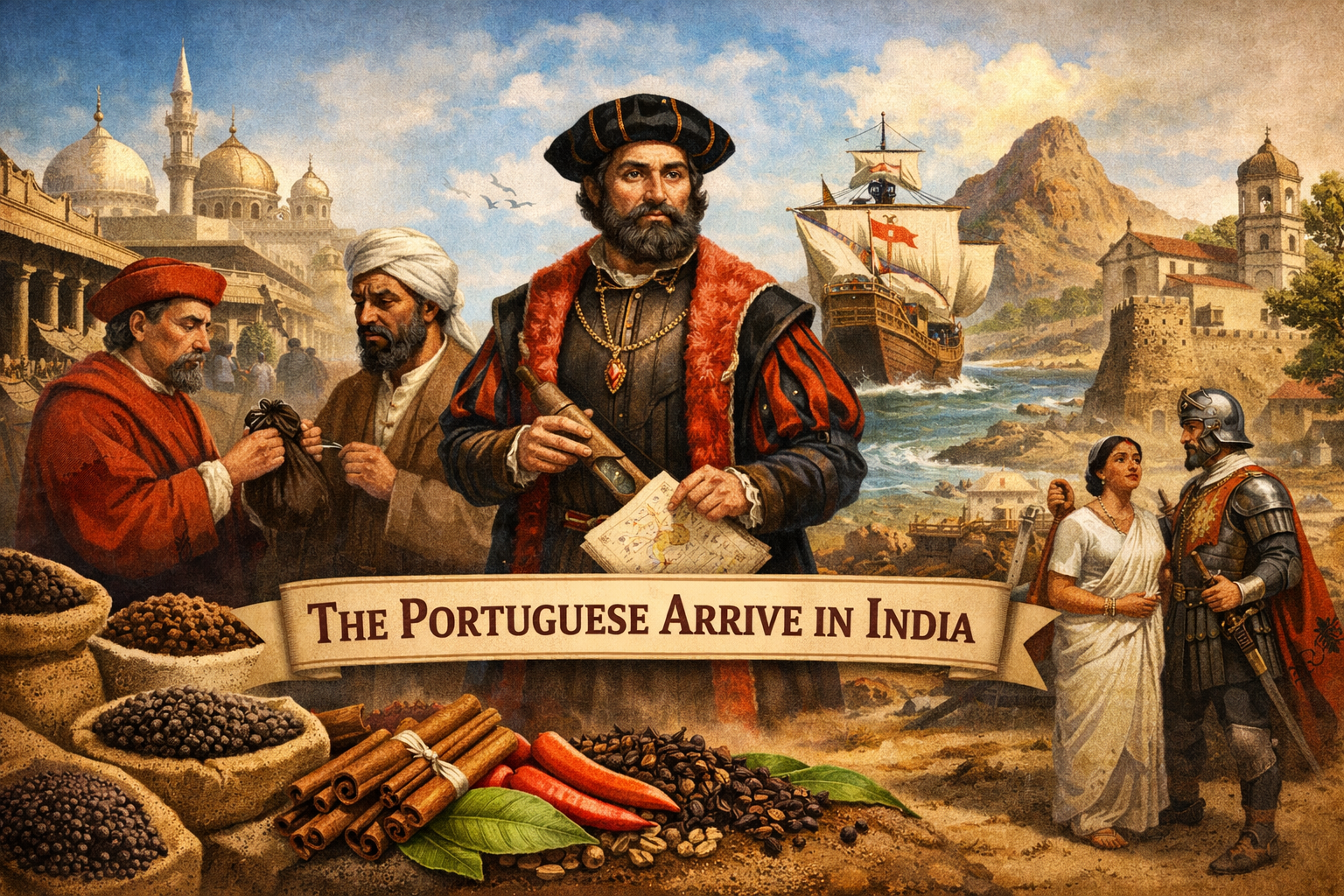
Before the Portuguese arrived in India, European trader depended on middlemen countries like venetian merchants and Arab to get spices from India. In the late 15th century, Europe wanted direct access to India to remove middlemen and get spices like pepper, cinnamon, and cloves.
These spices were very costly due to long traditional land routes and controlled by powerful middlemen and this pushed explorers to find cheaper and faster route to get access of India's spices. That's when the Portuguese stepped in.
Their journey changed world history. When they finally reached India, they didn’t just trade but established influence of west, built settlements and left their lasting cultural impact that we can still be seen in today, especially coastal places like Goa.
This is not even a simple reason why did the Portuguese come to India, and how their presence shaped both trade and culture in India. In this blog we will explore when, how and when did the Portuguese changed the whole trade history.
We have heard multiple times that Vasco da Gama was discoverer of India. In actual he founded a sea route between Europe to India. Vasco da Gama was a skilled navigator, who first arrived in India in 1498, marking a major turning point in the world history for global trade and travel.
After sailing around cape of good hope, the southern tip of Africa, his fleet entered the Indian ocean and finally reached the western coast of India. He landed at Calicut, which was then a major trading hub for spices in 15th century.
Earlier, trade between two regions depended on long and expensive land routes that controlled by middlemen. This voyage was significant because Vasco da Gama's arrival opened the door for direct trade, making spices and other export more accessible to Europeans. This moment is often referred to as the Portuguese arrival in India in 1498 not discovery of India by Vasco da Gama.
Main reasons why the Portuguese came to India
If you’re trying to understand why the Portuguese came to India, it mainly comes down in simple reasons. Here’s a clear breakdown:
Trade for spices
The most powerful driver was the spice trade. Spices like pepper, cinnamon, cloves and nutmeg were the extraordinarily valuable in Europe for preserving food, flavouring, and medicine. But at that time, trade of spices controlled by middlemen, making spices extremely expensive, then Portugal wanted direct sea access to the source to cut out the middlemen and capture those profits market.
Ottoman- Arab monopoly
Before the Portuguese arrival, trade with India happened through silk route and this route was controlled by ottoman empire and Indian ocean route by Arab merchants. After Constantinople fell in 1453, these routes become even more restricted and costly for Europeans. The Portuguese wanted a direct sea route to avoid middlemen.
Religious motivation
There was also a medieval legend of a Christian kingdom in the east ruled by “prester john,” which motivated the idea that India held potential for Christian allies. Portuguese crown was deeply catholic and saw expansion as an opportunity to spread Christianity and counter Islam.
What did the Portuguese do in India?
The Portuguese presence in India (roughly 1498 – 1961) left a deep and complex mark. They established an Estado da India (State of India) - a seaborne empire to build not to conquering land but to control sea routes. They captured India's important port cities – Goa (1510), Diu (1535), and Calicut – turning them into fortified trading hubs.
To capture coastal areas Portuguese regularly attacked Arab and Indian merchant vessels to break existing trade networks and enforce their monopoly. Naval warfare was central to their strategy. Their most important base was Goa, which became the center of their administration in India.
This direct influence of Portuguese entered several Indian languages – especially Konkani, which absorbed significant vocabulary. Many everyday Indian – English words actually came via Portuguese: pão (bread), vindaloo (from vinha d’alhos), and balcão (balcony). By the 17th century, the Dutch and English began overtaking Portuguese dominance in the Indian ocean.
The Portuguese presence in India had a lasting impact. While they brought new opportunities and connections, and also their rule that created challenges:
Boosted Trade: increased global connection and opened direct sea route trade between India and Europe without middlemen.
New crops introduced: crops like potatoes, tomatoes, and chillies, which become essential in Indian cuisine.
Cultural influence: influenced in architecture, food, music and lifestyle, especially in Goa.
Language Exchange: new words added in Indian language and encouraged cultural exchange.
Use of force: Portuguese often used military power to take control in trade routes.
Exploitation of resources: they only focused on profit, sometimes they exploited local for their resources.
Colonial rule: they established early forms of European colonialism in India especially in Goa.
Trade monopoly: tried to dominate trade routes to limit other traders in the Indian ocean.
Before English dominated, Portuguese was the world’s first truly global language. In the 16th and 17th centuries, it was the language of trade across coastal Africa, India, southeast Asia, Brazil, and Japan. Merchants, diplomats and traders of entirely different background learned Portuguese purely - making it arguably the first widely learned second language in the modern sense.
Research consistently shows that bilingualism and language learning reshape brain in measurable ways. Studies have found that Bilingual individuals show delayed onset Alzheimer's symptoms by an average of 4-5 years compared to monolinguals.
Language is not just a communication tool – it is carrier of worldview. Every language encodes a unique way to perceive time, relationships, and space. Learning a new language give partial access to that worldview, building empathy and reduce the unconscious assumption.
It unlocks opportunities across many countries because multinationals operating across borders need people who can negotiate, build relationships, and read cultural nuance things.
If learning about history has sparked your interest, starting Portuguese today is easier than you think. You don’t need to be perfect or prior experience – just a will to learn and stay consistent with it.
You can start you Portuguese learning journey with structured language course, as it provides guidance on grammar, vocabulary, and early mistakes in learning Portuguese that most beginner face. Along with that, try to practice daily Portuguese language with your friends or ai bot. Even a few minutes of speaking can make a big difference over time
If you want to learn faster and more effectively, enrol in structured course by linguapol. This course will guide your language learning journey and give confidence to use Portuguese language in real life.
1. What did the Portuguese bring to India?
Portuguese introduced new architectural styles, religious influences, and cultural practices and brought several new crops to India, including potatoes, tomatoes, and chillies, which later became essential parts of Indian cuisine.
2. Which route did the Portuguese use to reach India?
The Portuguese used sea route that went around cape of good hope the southern tip of Africa. This route was first successfully used and discovered by Vasco da Gama. Allowing direct trade between Europe and India.
3. What role did Goa play for the Portuguese in India?
Goa served as the main administrative and political center of the Portuguese in India. Goa became their capital in the region, where they managed trade and military operations.
4. Which place did the Portuguese control in India?
The Portuguese controlled several coastal regions of India, but their most important and long-lasting control was over Goa. They also had influence in other coastal trading area to maintain their dominance in the Indian ocean trade network.

Instructor: Mrs Raka Adhikari

Lectures: 42

Duration: 12 Weeks

Enrolled: 20 Students

Language: Portuguese
Medium of Instruction: English & Hindi

To keep up with this era of fast-paced globalization, the one skill that remains timeless is learning languages. It continues to be one of the most highly-paid career paths available. So if you are seeking a 100% placement guarantee, just indulge with us in a world full of foreign languages.
CIN - U85500DL2024NPL433420
ISO - 9001-2015